The Federal Insurance Form That Can Change a Truck Crash Case
Key Takeaways: The MCS-90 endorsement is a federally prescribed form that obligates an insurer to satisfy a final judgment for an injured person even when the carrier's policy would not respond, subject to reimbursement rights. Required under the Motor Carrier Act of 1980 to demonstrate financial responsibility, it operates under federal law even while Fort Lauderdale injury cases proceed under Florida law. It typically matters after judgment, particularly when carriers go bankrupt or insurers become insolvent. Florida adds weight-based minimums through Fla. Stat. § 627.7415 and § 324.151(1)(c), which prevents insolvency from relieving insurers. No endorsement pays until liability and damages are proven, making preservation of ELD data, driver files, maintenance records, and video critical. Florida's negligence deadline is now two years under Fla. Stat. § 95.11(4)(a) for claims accruing on or after March 24, 2023.
When a tractor-trailer causes serious harm on I-95, Broward Boulevard, or Powerline Road, the critical question is often not just "who was at fault" but "what insurance actually pays." The MCS-90 endorsement is a federally prescribed form attached to a motor carrier's liability policy that ensures injured members of the public can collect when a negligent interstate trucking company's coverage falls short. Under the Motor Carrier Act of 1980 and 49 C.F.R. part 387, covered carriers must demonstrate financial responsibility through an MCS-90 endorsement attached to insurance, a surety bond, or approved self-insurance. Courts treat it as a public-protection device rather than ordinary coverage.
If you were hurt in a crash with a commercial truck in Broward County, the team at Englander Peebles can help identify every policy that may respond. Call 954-226-9134 or contact us now to discuss your options with a Fort Lauderdale attorney who handles trucking claims.
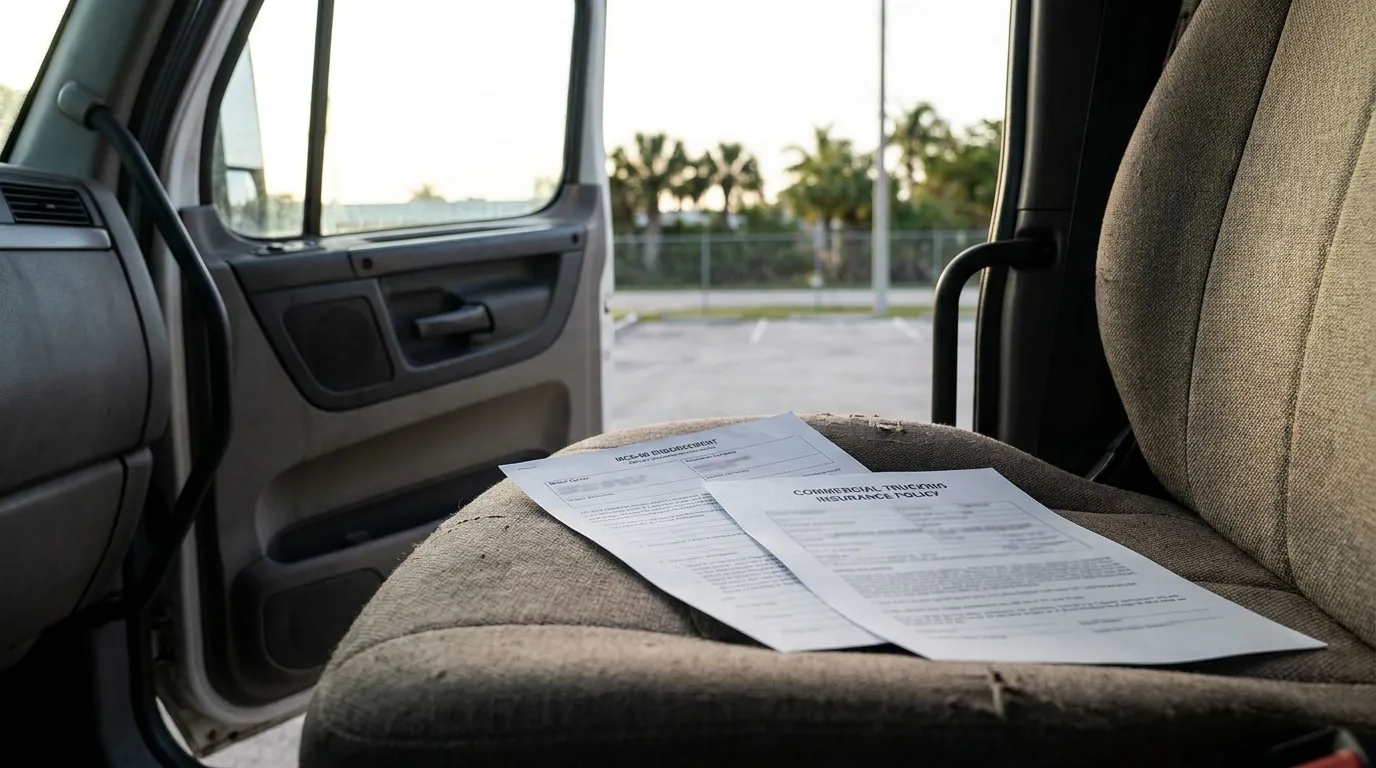
How the MCS-90 Endorsement Works After a Judgment
The MCS-90 endorsement is a safety net, not a standard insurance policy. A regular liability policy is a private contract between carrier and insurer, full of exclusions the insurer may raise. The endorsement changes that by operating as a suretyship to protect the public when the policy provides no coverage to the insured. An insurer may be obligated to pay a final judgment even when the carrier violated policy terms, subject to the insurer's reimbursement rights.
Federal law generally controls how it works. The Fourth Circuit in Canal Insurance v. Distribution Services, 320 F.3d 488 (4th Cir. 2003), held that the endorsement's operation is a matter of federal law, while the underlying insurance contract is construed under state law. For Fort Lauderdale truck crashes, your negligence case proceeds under Florida law while coverage fights may be resolved under federal standards.
The endorsement typically becomes relevant only when the underlying policy will not pay. In Wells v. Gulf Insurance Co., 484 F.3d 313 (5th Cir. 2007), an injured plaintiff obtained a judgment against a motor carrier, but the carrier's bankruptcy thwarted execution, so the plaintiff turned to the excess insurer. When a carrier collapses financially or a lower-layer insurer becomes insolvent, injured people look upstream, and outcomes depend on how the policy layer is structured.
Courts have not agreed on every question the endorsement raises. Federal circuits are split, with the majority holding that the endorsement does not control loss allocation among insurers, it protects the public, not insurers. Courts also divide on whether it applies to intrastate trips and whether it triggers before an unsatisfied judgment exists. Outcomes depend heavily on policy language, the carrier's financial responsibility method, and procedural posture.
The $1 Million Federal Threshold
Federal minimum financial responsibility varies by cargo. Under 49 C.F.R. § 387.9, for-hire carriers of non-hazardous property in vehicles over 10,001 pounds must carry at least $750,000, with $1 million and $5 million tiers for specified hazardous materials; many carriers contract for $1 million or more. Understanding which layer applies matters, because the endorsement is prescribed when insurance is the carrier's chosen method of meeting that minimum.
Where MCS-90 and BMC-91 Fit Together
The MCS-90 form and BMC-91 filing serve related but distinct functions. The MCS-90 is the endorsement attached to the policy; filings such as the BMC-91 certify that coverage to federal regulators. Claimants frequently pull FMCSA filing data early to identify insurers on the risk, though a filing is not proof of policy terms. Those records can also reveal safety history relevant to liability, which is why FMCSA violations in a truck crash claim deserve close attention.
💡 Pro Tip: Request the full declarations page, all endorsements, and any excess or umbrella policies in writing. Insurers are not required to volunteer the existence of layers you never ask about.
Florida's Own Rules on Commercial Truck Insurance
Florida layers its own minimum coverage requirements on top of the federal scheme. Under Florida's commercial vehicle insurance statute, Fla. Stat. § 627.7415, minimum liability limits for commercial motor vehicles scale with vehicle weight, and these state minimums are in addition to any applicable federal requirement.
| Gross Vehicle Weight | Minimum Coverage Per Occurrence |
|---|---|
| 26,000 to under 35,000 lbs | $50,000 |
| 35,000 to under 44,000 lbs | $100,000 |
| 44,000 lbs or more | $300,000 |
The statute's federal cross-reference is critical for MCS-90 discussions. Fla. Stat. § 627.7415 requires that commercial motor vehicles subject to U.S. Department of Transportation regulations under 49 C.F.R. part 387, subparts A and B, be insured in amounts equivalent to federal minimum financial responsibility levels, which exceed the state weight-based figures above.
Florida further protects injured claimants through its financial responsibility statute. Fla. Stat. § 324.151(1)(c) requires that qualifying motor vehicle liability policies provide that the insured's satisfaction of a judgment is not a condition precedent to the insurer's duty to pay, and that bankruptcy or insolvency of the insured does not relieve the insurer. The parallel to the federal endorsement is striking, both ensure a defendant's financial collapse does not erase an injured person's recovery.
Proving the Underlying Truck Accident Claim
No endorsement pays anything until liability and damages are established. Before coverage questions matter, a claimant must prove the driver or carrier owed and breached a duty of care and that the breach caused the injuries claimed. In trucking cases, proof often comes from sources that disappear quickly:
- Electronic logging device and telematics data showing hours behind the wheel
- Driver qualification files, drug and alcohol testing records, and training documentation
- Maintenance and inspection records for brakes, tires, and coupling devices
- Dashcam or facility video, which many carriers overwrite within weeks
- Bills of lading and dispatch records that may implicate a shipper or broker
Florida's comparative fault rules shape what a verdict is worth. Under Fla. Stat. § 768.81, as amended in 2023, damages are apportioned according to each party's share of responsibility, and a claimant found more than 50 percent at fault is barred from recovery; below that threshold, recovery is reduced by the claimant's percentage of fault. Trucking insurers invest heavily in shifting blame. Early scene documentation, witness statements, and prompt medical care affect how that apportionment argument plays out.
Deadlines You Cannot Afford to Miss
Florida's negligence limitations period is now generally two years. Fla. Stat. § 95.11(4)(a) sets a two-year window, changed by HB 837 (Ch. 2023-15) effective March 24, 2023, with the shorter deadline applying to causes of action accruing on or after that date; earlier claims remain subject to the prior four-year period. Courts interpret tolling and delayed-discovery exceptions narrowly. Wrongful death claims, claims against governmental entities with separate pre-suit notice requirements under Fla. Stat. § 768.28, and claims involving minors may follow different timing rules.
💡 Pro Tip: Send a written evidence preservation letter to the carrier as soon as possible. It does not require a filed lawsuit, and it puts the company on notice that destroying records may carry consequences.
Frequently Asked Questions
1. Does the MCS-90 endorsement mean I automatically get paid?
No. The endorsement obligates an insurer to satisfy a final judgment when the underlying policy would not respond, and the insurer may then seek reimbursement from the carrier. You must establish liability and damages first, and courts apply the endorsement according to federal standards that vary by circuit.
2. Does it apply to purely intrastate trucking in Florida?
Often not. The federal endorsement ties to interstate operations under the Motor Carrier Act of 1980 and 49 C.F.R. part 387, and some courts decline to apply it to purely intrastate trips. However, Fla. Stat. § 627.7415 imposes weight-based minimums on commercial vehicles operating in Florida, so state coverage requirements may still apply.
3. What happens if the trucking company is bankrupt?
Bankruptcy complicates execution but does not necessarily end the claim, though the automatic stay may require relief from the bankruptcy court. Under Fla. Stat. § 324.151(1)(c), qualifying policies must provide that the insured's insolvency does not relieve the insurer, and the federal endorsement was designed with similar collapses in mind.
4. How do I find out whether a truck had an MCS-90 endorsement?
Insurance filings with federal regulators, formal discovery, and pre-suit requests to the carrier are the usual routes. A truck accident lawyer Fort Lauderdale claimants trust can pursue those records while evidence is available.
5. Does PIP apply to a truck crash?
Florida's no-fault system means your own PIP coverage generally pays 80 percent of reasonable medical expenses up to $10,000 after a motor vehicle collision. PIP attaches to private passenger vehicles, so motorcyclists and many commercial vehicle operators are not covered. Injuries meeting the permanent injury threshold in Fla. Stat. § 627.737 may support a claim for pain and suffering against the at-fault trucking company beyond PIP.
Bringing the Coverage Picture Into Focus
The MCS-90 endorsement is one of the few tools in trucking law written primarily for the benefit of the injured public. It reflects a federal judgment that people harmed by interstate carriers should not be left empty-handed because of a policy exclusion or a company that folds after a catastrophic crash. Layered on top of Florida's weight-based minimums, financial responsibility requirements, and comparative fault framework, it can make the difference between a paper judgment and real compensation.
If a commercial truck injured you or someone you love in Fort Lauderdale, do not wait for the carrier's insurer to explain your rights. Englander Peebles is ready to review the policies, chase down the records, and pursue accountability. Call 954-226-9134 or schedule your free case review today.