When a Stair Railing Gives Way: Understanding Your Rights in Broward County
Key Takeaways: A broken handrail fall injury claim in Fort Lauderdale is a premises liability case arising when a property owner or manager fails to keep a stairway railing in reasonably safe condition and someone is hurt as a result. Unlike a typical slip and fall, these cases involve structural defects like loose anchors, corroded brackets, or rotted posts that develop over time, making maintenance records, inspection logs, and prior complaints central evidence. Recovery generally requires proving duty, breach, causation, and damages, with your visitor status as an invitee, licensee, or trespasser shaping the duty owed and notice often deciding liability. Multiple parties, including owners, management companies, maintenance vendors, and installers, may share fault. Florida generally allows two years to file a negligence lawsuit for claims accruing on or after March 24, 2023, while claims involving government property follow different deadlines and pre-suit notice rules, and comparative fault can reduce or, in most negligence cases, bar recovery if the injured person is found more than 50 percent at fault. Acting quickly to preserve photographs, incident reports, witness information, and surveillance footage may give an attorney a stronger foundation to work with.
A broken handrail fall injury claim is a premises liability case brought by someone hurt because a property owner or manager failed to maintain a stairway railing in reasonably safe condition. You grab the rail on a stairwell in an apartment building, parking garage, restaurant patio, or office in downtown Fort Lauderdale, and it wobbles, pulls loose, or breaks away entirely. The fall that follows often causes fractures, head injuries, or spinal damage. Under Florida law, if the owner knew or should have known the railing was defective and failed to repair it or warn visitors, you may be able to seek compensation for medical bills, lost wages, and pain and suffering, depending on the circumstances.
If you were hurt when a railing failed, acting sooner may help support your case. Photographs, incident reports, and witness contact information disappear quickly, and repairs are often made within days. The team at Englander Peebles helps injured people across Broward County understand their options and preserve evidence before it is gone. Call 954-226-9134 or contact us now for a free consultation.
What Makes a Handrail Collapse Injury Different From a Typical Slip and Fall
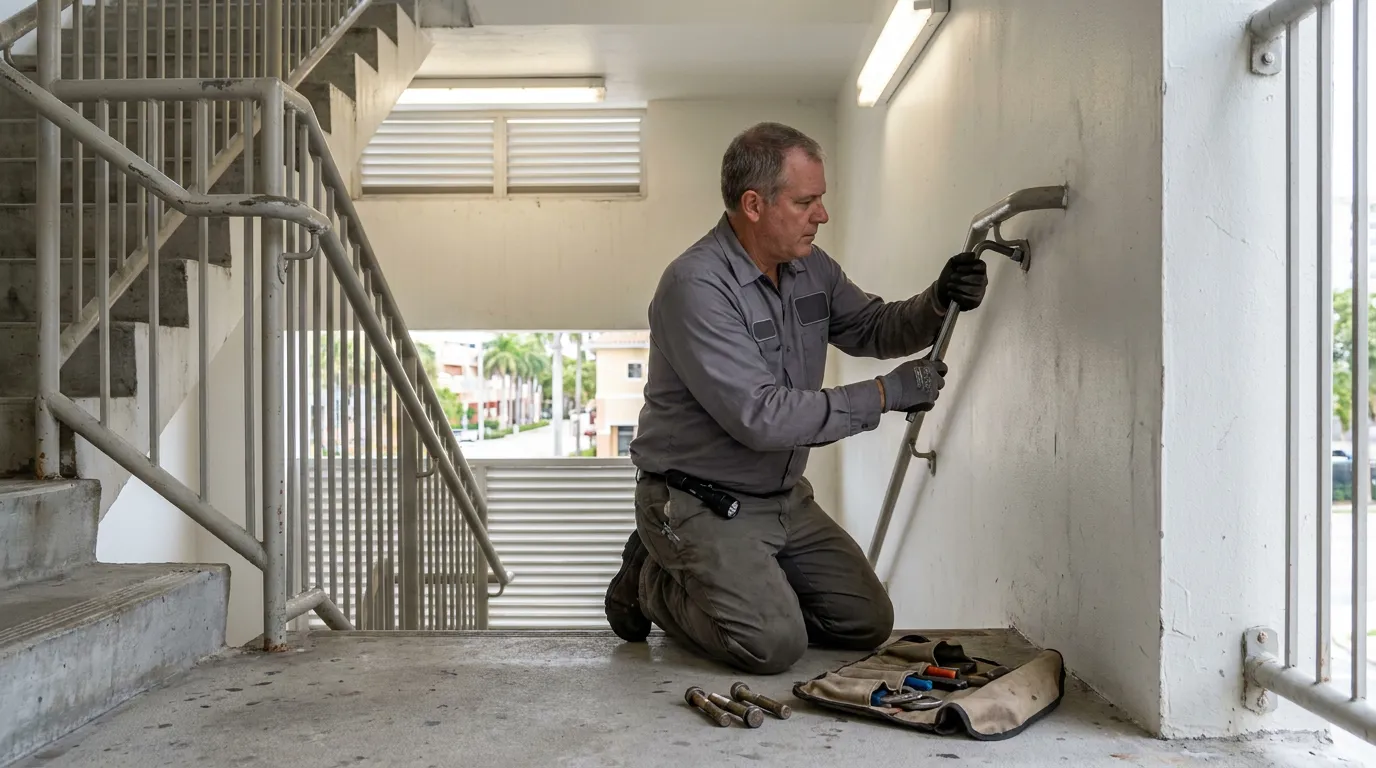
A handrail collapse injury usually involves a structural defect rather than a temporary spill. Defective stairs and broken railings are among the most commonly cited grounds for a premises liability claim. A wet floor may exist for minutes. A loose anchor, corroded bracket, or rotted post typically develops over months or years, which can make it easier to argue the owner should have discovered it during reasonable inspection, though the owner may still dispute how long the defect was detectable.
That distinction shapes the evidence your case depends on. In a spill case, the fight is often about how long the substance was on the floor. In a railing failure case, the focus shifts to maintenance records, inspection logs, prior complaints, code compliance, and the physical condition of the hardware itself. Salt air in South Florida accelerates corrosion on exterior metal railings, a factor that frequently comes up in coastal Broward and Miami-Dade properties.
Injuries from these falls tend to be serious because the victim is usually mid-stair and unable to catch themselves. A person reaching for support who finds nothing there falls with full body weight onto hard treads. Common outcomes include wrist and hip fractures, traumatic brain injuries, rotator cuff tears, and herniated discs, which can mean surgery, months away from work, and long-term limitations.
The Legal Elements Behind a Broken Handrail Fall Injury Claim
Every claim of this type generally rests on four building blocks: duty, breach, causation, and damages. General negligence principles require showing that someone owed you a duty of reasonable care, failed to meet it, and caused you harm as a result. In the premises context, this generally means the owner or occupier owed you a duty based on your reason for being there, allowed a dangerous condition to exist, and that condition caused your injury and losses.
How Your Visitor Status Affects the Duty Owed
Florida courts generally evaluate the owner's duty based on whether you were an invitee, licensee, or trespasser. Invitees, such as customers or tenants' guests, are typically owed the highest duty of care, generally including reasonable inspection and repair or warning. Licensees, often social guests, are usually owed a narrower duty to warn of known dangers that are not open and obvious. Trespassers are generally owed the least, and Fla. Stat. § 768.075 limits a landowner's liability to undiscovered and discovered trespassers, subject to exceptions such as intentional misconduct and the attractive nuisance doctrine involving children.
| Visitor Status | Typical Examples | General Duty Owed |
|---|---|---|
| Invitee | Shoppers, hotel guests, tenants, delivery workers | Reasonable care, including inspection and repair or warning |
| Licensee | Social guests, non-business visitors | Warning of known dangers not obvious to the visitor |
| Trespasser | Uninvited entrants | Limited duty, subject to statutory and case law exceptions |
Because classification is fact-dependent and a visitor's status can change during a visit, outcomes vary from case to case.
Proving the Owner Knew or Should Have Known
Notice is often the central battleground in a defective handrail claim. For injuries caused by a transitory foreign substance, Fla. Stat. § 768.0755(1) requires the injured person to prove the business had actual or constructive knowledge of the dangerous condition and should have remedied it. Constructive knowledge can be shown circumstantially, by proving the condition existed long enough that ordinary care would have revealed it, or that it occurred with regularity and was foreseeable.
That statute does not swallow the broader common law. Fla. Stat. § 768.0755(2) provides that the section does not affect any common-law duty of care owed by a person or entity in possession or control of a business premises. A structurally defective railing is generally analyzed under traditional negligence principles rather than the transitory substance rule, though notice concepts like prior complaints and inspection history still carry weight. A plaintiff may also argue the owner created the condition or that a nondelegable duty applies. For more, see this guide on how negligence is proven in local fall cases.
When More Than One Party May Share Responsibility
Handrail cases frequently involve several potentially responsible parties, the building owner, property management company, maintenance contractor, or the company that installed or last repaired the railing may each bear some fault. Under Fla. Stat. § 768.81, the fact-finder generally apportions fault among the parties rather than placing it all on one defendant, and liability for noneconomic damages is several rather than joint. A separate statute, Fla. Stat. § 768.0701, addresses premises claims against owners for the criminal acts of third parties and applies to negligent security claims rather than ordinary maintenance-defect cases.
💡 Pro Tip: Ask the property manager, in writing, for the name of the maintenance vendor responsible for the stairwell. Identifying every potentially responsible party early can matter when insurance limits are low.
Deadlines That Can End a Fort Lauderdale Fall Claim
Florida generally gives you two years to file a negligence lawsuit. Fla. Stat. § 95.11 provides a two-year limitations period for negligence actions accruing on or after March 24, 2023; claims accrued before that date are generally governed by the prior four-year period. Missing the applicable window typically bars recovery entirely, no matter how strong the underlying facts are. Certain limited tolling doctrines exist, such as for minors or legal incapacity, but Florida courts generally interpret exceptions narrowly.
Claims against government entities follow a different track. If the railing failed at a city building, public park, courthouse, or other government facility, Fla. Stat. § 768.28(14) provides that claims against the state or its agencies are barred unless commenced within four years of accrual, with a shorter two-year period for wrongful death claims. Sovereign immunity law also requires written pre-suit notice to the agency, and to the Department of Financial Services in most cases, generally within three years of accrual, and a claimant ordinarily must wait for a denial or the agency's 180-day review period to pass before suing. Statutory damage caps also apply. Because these rules are technical, confirming the correct deadline with an attorney early is wise.
Evidence That Strengthens a Defective Handrail Claim
Strong cases are often built in the first days after the fall. Property owners repair broken railings quickly, and once the hardware is replaced, the central piece of physical evidence may be gone.
- Photographs and video of the railing, its anchors, the stairs, and lighting from multiple angles
- The written incident report, plus the name of the manager who took it
- Names and phone numbers of anyone who saw the fall or previously complained about the rail
- Medical records connecting your injuries to the date and mechanism of the fall
- The shoes and clothing you were wearing, stored unwashed
- A written request that the owner preserve surveillance footage and maintenance records
A preservation letter sent promptly can make a meaningful difference. Surveillance systems in many South Florida buildings overwrite footage within a short window. An attorney can send a formal spoliation notice asking the owner to retain video, work orders, and the removed railing hardware. Florida does not recognize an independent cause of action for first-party spoliation, but courts may impose evidentiary sanctions or allow an adverse inference when evidence is destroyed after notice.
💡 Pro Tip: Avoid giving a recorded statement to the property's insurer before speaking with counsel. Adjusters often ask questions designed to elicit admissions about your attention, footwear, or phone use.
How Comparative Negligence Affects Handrail Injury Compensation
Florida's modified comparative fault system may allow recovery even when the injured person shares some blame, with damages generally reduced by that percentage. Section 768.81 within the Florida Statutes chapter on negligence actions governs how fault is apportioned and, for causes of action accruing on or after March 24, 2023, bars recovery entirely when the claimant is found more than 50 percent at fault. The defense may argue you were distracted, hurrying, carrying items, or not using the railing properly.
Those arguments are frequently overstated and can often be answered with evidence. Poor stairwell lighting, missing warning signage, code violations, and prior tenant complaints all tend to shift focus back to the property's condition. Because crossing the 50 percent threshold can eliminate recovery altogether, the percentage assigned is not a minor detail. Outcomes depend heavily on specific facts, so no general article can predict how a particular case will resolve.
Frequently Asked Questions
1. What compensation might be available after a stairway fall?
Damages may include past and future medical expenses, lost income, reduced earning capacity, pain and suffering, and, in some circumstances, home modification costs. Value depends on injury severity, treatment needs, available insurance, and the strength of the liability evidence. No attorney can promise a particular result.
2. Does it matter if the handrail violated building code?
It can matter a great deal. Evidence that a railing's height, spacing, or anchoring failed to meet applicable code standards may support the argument that the property was unreasonably dangerous, although code compliance alone does not automatically resolve the negligence question, and the effect of a violation depends on which code applied when the stairway was built or altered.
3. I fell in my apartment building's stairwell. Can I still bring a claim?
Possibly. Landlords and management companies generally owe tenants a duty to maintain common areas such as stairwells and railings in reasonably safe condition, and Fla. Stat. § 83.51 imposes related maintenance obligations in residential tenancies. Prior maintenance requests about the railing can be persuasive evidence of notice.
4. What if I did not report the fall right away?
A delayed report may make the case harder but does not necessarily end it. Medical records, photographs, text messages to family, and witness statements can help establish when and how the fall occurred. Speaking with a lawyer promptly is generally the better course.
5. Should I accept the insurer's first offer?
Early offers are often made before the full scope of an injury is known, particularly when surgery or long-term treatment may still be ahead. Reviewing any offer with counsel before signing a release is generally advisable, since a release usually ends your claim permanently.
Moving Forward After a Railing Failure
A broken handrail fall injury claim in Fort Lauderdale generally turns on proving that a property owner owed you a duty, allowed a dangerous condition to persist, and caused real harm. Your visitor status may shape the duty owed, notice evidence often influences the liability fight, comparative fault can reduce or bar recovery, and strict filing deadlines may apply. Because every property, every railing, and every injury is different, the only reliable way to understand your position is to have the facts reviewed by a broken handrail fall injury claim lawyer who handles these cases in Broward County.
You do not have to figure this out while you are still healing. The attorneys at Englander Peebles serve injured people throughout Fort Lauderdale, Broward County, and the tri-county area, and they are ready to listen. Call 954-226-9134 or schedule your free case review today.
Disclaimer: This content is for informational purposes only and is not legal advice. Every case is unique, and results may vary. Consult an attorney about your specific circumstances.