Driver Qualification Files: The Hiring Paper Trail Behind Every Big Rig
Key Takeaways: A driver qualification file is the record a trucking company must keep for each driver, showing it checked whether the driver was qualified before letting them drive a commercial truck. Under 49 CFR Part 391, the file generally must include the driver's employment application, a road test certificate or accepted substitute, a motor vehicle record from each state where the driver was licensed, prior employer safety performance inquiries, a medical examiner's certificate or related record, and annual reviews of the driver's driving record. Florida law generally applies these federal rules to both interstate and intrastate carriers, though some intrastate exceptions apply, and the state can enforce them with civil penalties and out-of-service orders. After a truck crash, missing or outdated records, or ignored warning signs in the file, can support claims that the carrier was negligent in hiring, training, keeping, or supervising the driver. A violation alone doesn't prove the carrier caused the crash, so you generally need to show a link between the violation and the collision. Because some records may only need to be kept for a limited time, talking to an attorney early can help preserve this key evidence.
A driver qualification file is the record a trucking company has to keep showing that it checked whether a driver was qualified before letting them drive a commercial truck. Under 49 CFR § 391.51(a), "each motor carrier shall maintain a driver qualification file for each driver it employs." After a truck crash, this file can show whether the carrier did its job when it hired and supervised the driver. Missing papers, outdated records, or ignored warning signs can make it important truck accident evidence.
If a commercial truck hurt you or someone you love, the trucking company's records can be time-sensitive. Englander Peebles helps injured people across Broward County investigate trucking companies and hold them accountable. Call 954-226-9134 or contact us now to talk about your situation. Call us today for a free consultation.
What Federal Driver Qualification File Requirements Cover
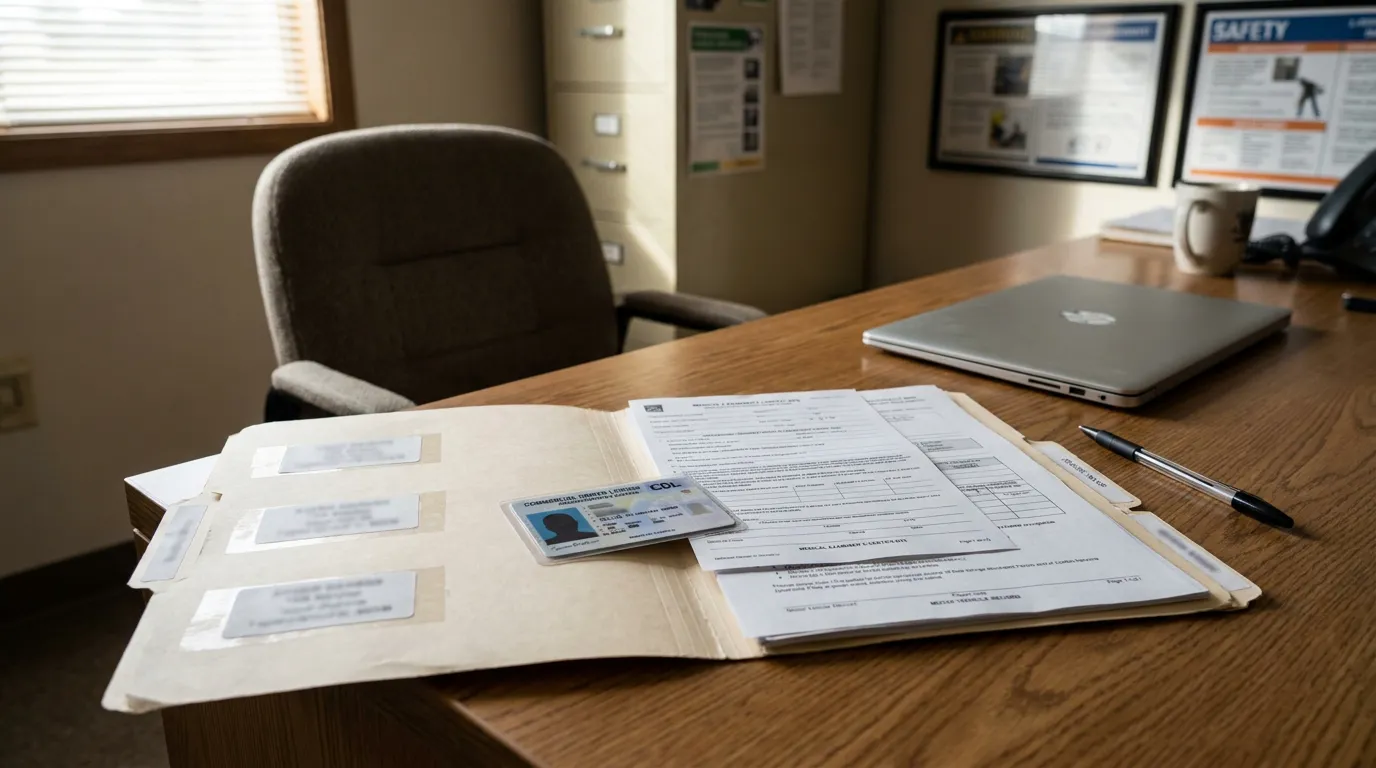
The Federal Motor Carrier Safety Administration (FMCSA) requires motor carriers to keep a qualification file for each driver under 49 CFR Part 391. FMCSA collects guidance on these rules on its driver qualification files page. The rules cover hiring, medical fitness, testing, and ongoing monitoring, setting the minimum a carrier generally must do before and after putting someone behind the wheel. Some exceptions apply, for example to certain intermittent, casual, or occasional drivers.
Core Documents the File Must Contain
Under 49 CFR § 391.51(b), the required documents generally include the following, along with others such as motor vehicle records and prior employer inquiries:
- Employment application: Completed under 49 CFR § 391.21. It shows what the carrier knew about the driver's history when it hired them.
- Road test certificate: The certificate of the driver's road test, or a copy of the license or certificate the carrier accepted in its place under 49 CFR § 391.33.
- Medical examiner's certificate: Proof that a medical examiner found the driver physically qualified. For CDL holders, this may be a motor vehicle record showing medical certification status.
- Annual driving record review: The carrier's yearly review of the driver's driving record.
Why Each Document Matters in a Claim
Every one of these documents can matter to a truck accident claim in its own way. The application can show whether the company asked about past violations or crashes, or overlooked them. The road test record can show whether the driver was tested before driving a commercial vehicle. The medical certificate can help answer whether the driver was medically certified at the time of the collision. If any is missing, that gap can be part of the story.
How Florida Law Applies These Federal Rules on Local Roads
Florida generally adopts the federal driver qualification rules, so they generally apply to trucks on Fort Lauderdale roads. Under Fla. Stat. § 316.302(1)(a), owners and drivers of commercial motor vehicles engaged in interstate commerce on Florida highways are subject to 49 CFR parts 382-386 and 390-397, which includes Part 391. An interstate carrier traveling I-95 or I-595 through Broward County generally must follow these rules.
Trucks That Never Leave Florida
Carriers that operate only within Florida may also be covered. Fla. Stat. § 316.302(1)(b) applies the same federal parts, including Part 391, to intrastate commerce. Unless the statute provides otherwise, those rules apply as they existed on December 31, 2023. Section 316.302 also includes intrastate exceptions, such as modified rules for certain drivers, vehicle weights, and agricultural operations. You can read these provisions in Florida's traffic control statutes.
The CDL Check
One of the most basic steps in truck driver hiring is confirming that the driver holds a valid commercial driver license. Under Fla. Stat. § 322.53(1), with limited exceptions, anyone who drives a commercial motor vehicle in Florida must have a valid CDL. If a carrier never checked, that failure can raise serious questions about how it hires.
Penalties Florida Can Impose on Noncompliant Carriers
Florida can enforce these rules with civil penalties and out-of-service orders. These are administrative actions, separate from an injured person's civil lawsuit, but the findings may still help show a pattern of carelessness.
| Enforcement Situation | Possible Consequence | Statute |
|---|---|---|
| Violation of 49 CFR 391.41 (physical qualification) | $100 civil penalty | Fla. Stat. § 316.3025(3)(b)5. |
| Violations found in a first compliance review | Up to $5,000 in total | Fla. Stat. § 316.3025(3)(e) |
| Follow-up review within 24 months | Up to $25,000 | Fla. Stat. § 316.3025(3)(e) |
| Second follow-up within 12 months | Up to $25,000 plus possible injunction | Fla. Stat. §§ 316.3025(3)(e), 316.3026 |
| Operating while under an out-of-service order | $10,000 penalty; knowing violation is a third-degree felony | Fla. Stat. § 316.3026(2) |
Under Fla. Stat. § 316.3026(1), Florida's Office of Commercial Vehicle Enforcement may issue out-of-service orders against carriers. Reasons include refusing a compliance review or refusing to provide records, violating safety regulations, or failing to pay assessed penalties. While the order is in effect, the carrier's vehicles generally may not operate on Florida roads.
Turning Trucking Company Records Into Proof of Negligence
The file can support claims that a carrier was negligent in hiring, training, retaining, or supervising a driver. These claims focus on what the company may have done wrong, not only on the driver's mistakes at the scene. If the driver was acting within the scope of employment, the carrier may also be vicariously liable for the driver's negligence. To learn how regulatory violations can fit into a case, read our article on using FMCSA violations in a claim.
A violation does not automatically prove that the carrier caused your crash. Courts generally require a causal link between the violation and what happened. In Florida, a safety regulation violation may be treated as evidence of negligence rather than automatic liability. For example, an expired medical certificate may carry more weight if a medical episode contributed to the collision. Under Florida's modified comparative negligence rule, an injured person found more than 50% at fault generally cannot recover damages, and any recovery is reduced by their share of fault.
💡 Pro Tip: Keep a written list of everything you remember about the truck, such as the company name on the door, the USDOT number, and the trailer markings. These details can help identify the carrier whose records your attorney may need.
Common Problems We See With Commercial Driver Records
Accident victims in Broward County often assume the trucking company will simply hand over its files. That is often not how it works. Records may be incomplete, created after the fact, or kept by a different company when leasing arrangements or brokers are involved. Federal rules also let carriers discard some file documents after three years and keep files for only three years after a driver leaves. Common problems include:
- Applications with gaps in employment or missing prior-employer checks
- Medical certificates that expired before the crash
- No road test certificate or equivalent on file
- Annual reviews that were skipped or only signed without a real review
Acting early can help protect this evidence. An attorney can send preservation demands and, once a lawsuit is filed, use formal discovery to get the file. Talking with a Fort Lauderdale truck accident lawyer soon after the crash may help keep important records from being lost.
Frequently Asked Questions
1. Can I request a driver qualification file myself?
Carriers generally have no duty to give their files directly to the public. In most cases, these records come out through litigation discovery, often after an attorney's preservation letter.
2. Do the driver qualification file requirements apply to small local carriers?
Under Fla. Stat. § 316.302(1)(b), intrastate carriers are generally subject to Part 391, subject to the exceptions in that section. A truck that never leaves Florida can still be covered.
3. What if the driver had a valid CDL?
A valid CDL is only one part of being qualified. The carrier may still have failed to check the driver's history, medical fitness, or driving record.
4. How long do I have to file a truck accident claim in Florida?
For negligence claims arising on or after March 24, 2023, Florida's deadline is generally two years. Earlier claims, wrongful death claims, and claims against government entities may follow different rules. Please consult an attorney promptly to confirm the deadline that applies to you.
5. Does PIP cover truck crash injuries?
Under Florida's no-fault system, your own PIP coverage generally pays first for certain medical expenses and lost wages, up to policy limits. A claim beyond PIP against the driver and carrier generally requires a serious injury that meets Florida's permanent injury threshold.
Protecting Your Right to the Truth After a Truck Crash
The driver qualification file can show whether a trucking company cut corners before a crash ever happened. Federal and Florida law set clear requirements, and gaps in those records may support a claim against the carrier. Every case is different, so get guidance that fits your facts as early as you can.
You should not have to take on a trucking company and its insurer by yourself. Englander Peebles answers the phone and is ready to look into what happened. Call 954-226-9134 or reach out online today. Contact Englander Peebles today.
Disclaimer: This content is for informational purposes only and is not legal advice. Every case is unique, and results may vary. Consult an attorney about your specific circumstances.