When a Backyard Hazard Turns Into a Serious Child Injury
Key Takeaways: Florida's attractive nuisance doctrine may allow a property owner to be held liable when an artificial, dangerous condition that predictably draws children, like an unfenced pool, construction site, or abandoned equipment, injures a child who wandered onto the land. Courts generally examine whether the owner knew or should have known children were likely to enter, whether the hazard posed an unreasonable risk of serious injury, whether the child was too young to appreciate that risk, and whether securing the hazard would have been relatively easy compared to the danger. Florida Statutes § 768.075 limits liability to trespassers generally, but it expressly preserves the common-law attractive nuisance doctrine as it applies to children. Parents must still prove the four negligence elements, duty, breach, causation, and damages, and comparative negligence arguments about the child's conduct may reduce recovery, although a claimant more than 50% at fault is generally barred entirely under Florida's modified comparative negligence statute. A two-year negligence deadline generally applies to causes of action accruing on or after March 24, 2023, with narrow tolling for minors and potentially much shorter pre-suit notice rules when a government entity owns the property. Because evidence like gates, latches, and footage can disappear quickly, early legal guidance is often critical in Broward County child injury claims.
The attractive nuisance doctrine is a long-standing rule in Florida premises liability law that may allow a property owner to be held responsible when a child wanders onto their land and is hurt by a dangerous artificial condition that drew the child in, think an unfenced pool, unsecured construction site, abandoned equipment, or accessible trampoline. Children do not weigh risk the way adults do, and Florida law recognizes that. Even though property owners generally owe limited duties to trespassers, the law may treat child trespassers differently when the hazard is one that predictably attracts them.
If your child was hurt on someone else's property in Broward County, the sooner you talk to a lawyer, the better. Evidence can disappear quickly: gates get repaired, fences go up, witnesses move away. The team at Englander Peebles has handled premises liability claims throughout South Florida and can review what happened at no cost. Call 954-226-9134 or reach out to our Fort Lauderdale personal injury attorneys to get started.
How the Attractive Nuisance Doctrine Florida Courts Apply Actually Works
At its core, the doctrine asks whether a property owner knew, or reasonably should have known, that a hazardous condition on the land was likely to attract children who could not appreciate the danger. Florida courts generally weigh overlapping considerations drawn from the Restatement approach: whether the owner knew or had reason to know children were likely to come onto the property, whether the condition posed an unreasonable risk of serious injury or death, whether the child was too young to understand that risk, and whether the burden of eliminating or securing the hazard was slight compared to the danger involved.
This is a fact-intensive analysis, and outcomes depend heavily on the circumstances. A six-year-old who slips into an unfenced pool may be viewed very differently than a sixteen-year-old who climbs a locked fence at night. Courts may consider the child's age, maturity, and prior warnings when deciding whether the doctrine applies. Florida courts have also declined to apply the doctrine to certain ordinary bodies of water and dangers considered obvious even to children, so the doctrine is not automatic simply because a child was injured.
Why the Doctrine Exists in the First Place
Florida's appellate courts have wrestled with landowner duties toward children for generations. A 1959 Florida Supreme Court decision reported at 110 So. 2d 649 is often cited in discussions of how courts analyze liability when a child is injured by a condition on someone else's property. Because it comes from the state's highest court, its decisions generally bind lower courts statewide, including those in Broward County, to the extent not superseded by later decisions or statute.
Later appellate decisions continued refining the analysis. A 1969 District Court of Appeal opinion at 227 So. 2d 686 addressed similar questions about landowner knowledge and a child's capacity to appreciate risk, the same balance modern courts still strike. These older cases explain where the doctrine came from and why it survived statutory reform, but current law should always be confirmed against later decisions and governing statutes.
The Statute That Protects Child Trespassers From Being Shut Out
Florida Statutes § 768.075 generally limits property owners' civil liability for injuries to trespassers, but the Legislature preserved an important exception for children. The statute expressly states that its provisions "shall not be interpreted or construed to alter the common law as it pertains to the 'attractive nuisance doctrine.'" That single sentence can preserve a child's claim even where an adult in the same position may have none.
The statute also defines trespasser categories that matter here. An "undiscovered trespasser" is someone who enters without invitation and whose presence was not detected within the 24 hours preceding the accident, a common pattern involving pools, construction sites, or abandoned machinery. For a discovered trespasser, the statute generally requires the owner to refrain from gross negligence or intentional misconduct and to warn of known dangerous conditions not readily observable. For an undiscovered trespasser, the owner must refrain from intentional misconduct, meaning gross negligence alone does not pierce immunity in that category. The statute also expands owner protection in certain circumstances: under subsection (1), a property owner is shielded from liability when a trespasser is under the influence of alcohol or controlled substances, and under subsection (4), the owner is not liable for negligence causing injury to a person committing a felony on the property. Critically, the statute expressly preserves the common-law attractive nuisance doctrine as an independent exception that may impose liability for child trespassers regardless of the gross negligence threshold.
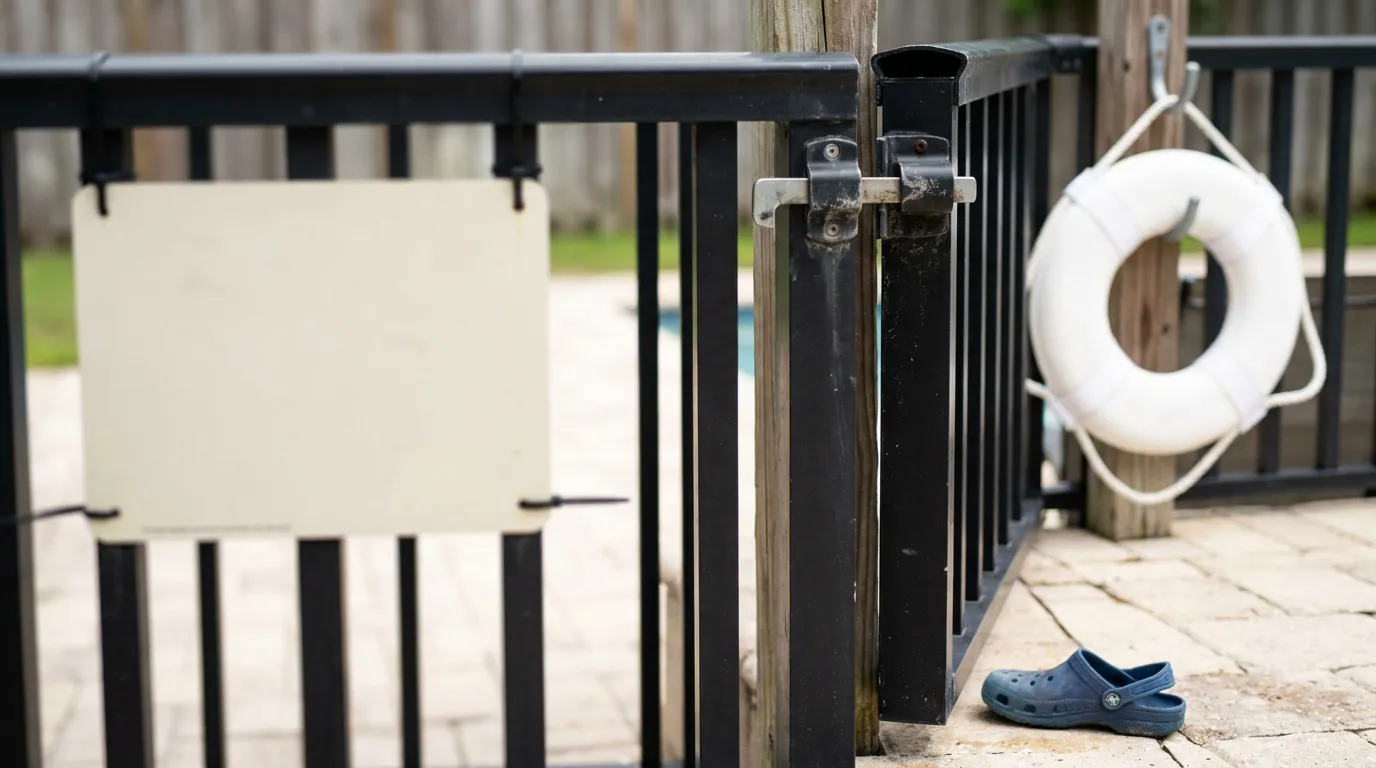
The duty owed to children can go further. Under attractive nuisance principles, a warning sign may not be enough when a young child cannot read or understand it; a reasonable step may instead be actively preventing access through fencing, locks, covers, or barriers. Separately, Florida's Residential Swimming Pool Safety Act imposes barrier and safety-feature requirements on many residential pools, and noncompliance may be relevant evidence of negligence.
| Category | General Duty Owed | How Child Claims Differ |
|---|---|---|
| Undiscovered trespasser | Very limited duty under § 768.075 | Attractive nuisance exception may still apply |
| Discovered trespasser | Avoid gross negligence; warn of known, non-obvious hazards | Warnings may be inadequate for young children |
| Child drawn by a hazard | Common-law attractive nuisance analysis | Owner may need to secure or eliminate the condition |
Conditions That Commonly Trigger These Claims
Certain hazards come up repeatedly in Broward child injury claims because they are both dangerous and irresistible to kids:
- Swimming pools without compliant fencing, self-latching gates, or alarms
- Active or abandoned construction sites with open trenches, ladders, or materials
- Unsecured heavy machinery, farm equipment, or abandoned vehicles
- Trampolines, treehouses, and play structures in disrepair
- Retention ponds, canals, and unsecured water features
- Discarded appliances, electrical boxes, and exposed wiring
Drowning remains a leading cause of unintentional injury deaths in young children, and in a region full of backyard pools and waterways, pool cases make up a significant share of the child premises claims we see. Whether any of these conditions supports a claim still depends on the specific facts and legal analysis described above.
💡 Pro Tip: Photograph the property condition the same day if you safely can, including gates, latches, fence height, and any missing barriers. Owners often fix the hazard within days, and those repairs can be difficult to reconstruct later.
What Parents Must Prove in a Broward Child Injury Claim
An attractive nuisance case is still a negligence case, so the same four elements generally apply. You would generally need to establish duty, breach, causation, and compensable damages. Chapter 768 of the Florida Statutes provides much of the statutory framework for negligence claims, including provisions governing landowner and occupier liability.
Damages can often extend well beyond the initial hospital bill. Future medical care, therapy, adaptive equipment, diminished earning capacity, and pain and suffering may all factor into a full evaluation. Parents may also have separate derivative claims, such as for medical expenses they paid on the child's behalf.
Florida's comparative negligence framework can also come into play. Under § 768.81, as amended in 2023, damages are generally reduced by the claimant's percentage of fault, and a claimant found more than 50% at fault in most negligence actions is barred from recovery altogether. A defense may argue the child's own conduct contributed to the incident, although Florida law has long treated very young children as incapable of negligence, and a parent's alleged failure to supervise is generally not imputed to the child, though it may support a separate claim against the parent. How much weight these arguments carry depends on the child's age and circumstances.
Working With a Child Injury Lawyer in Fort Lauderdale
These cases often move faster than most families expect, and early legal guidance can change what evidence survives. An attractive nuisance doctrine Florida lawyer can send preservation letters, obtain code enforcement and permit records, identify potentially responsible parties, and retain professionals to evaluate pool barrier compliance or site security. Property owners, contractors, property management companies, and HOAs may all share responsibility depending on who controlled the premises.
Families researching their options often start by reading about how child injury legal help works in South Florida before making a call. That is a reasonable first step, though every claim turns on its own facts and no article can substitute for a case-specific consultation.
Deadlines That Can Quietly End a Claim
Attractive nuisance claims sound in negligence, so Florida's limitations period for negligence actions generally governs, subject to exceptions. Florida Statutes § 95.11(4)(a) sets a two-year window for negligence actions accruing on or after March 24, 2023; claims accruing before that date are generally governed by the prior four-year period. Missing the deadline can foreclose the claim entirely, regardless of how strong the underlying facts may be.
Tolling for minors exists, but it is narrower than many parents assume. Under Florida Statutes § 95.051(1)(i), the limitations period may be tolled while a minor has no parent, guardian, or guardian ad litem, or when the parent or guardian has an adverse interest or has been adjudicated incapacitated to sue. Even then, the action generally must be commenced within seven years of the act, event, or occurrence giving rise to the cause of action, and the provision does not apply to medical malpractice actions. Courts generally interpret these exceptions narrowly, so no family should assume tolling applies automatically simply because the injured person is a child.
There is also a protective step at the end of a successful case. Florida's rules of procedure and Florida Guardianship Law generally require court oversight of settlements and awards for a minor child once the net amount exceeds statutory thresholds, which may mean a guardianship, a guardian ad litem, a restricted depository, or a structured settlement.
💡 Pro Tip: If a government entity owns the property, such as a city park or school district site, separate pre-suit notice requirements under Florida Statutes § 768.28 can apply, along with statutory caps on recoverable damages. Those administrative deadlines are distinct from the civil statute of limitations and are often much shorter.
Frequently Asked Questions
1. Does the attractive nuisance doctrine apply to teenagers?
It may, but the analysis gets harder as children age. Courts generally consider whether the child was capable of appreciating the specific risk involved. A teenager who understood the danger and chose to engage anyway may face a more difficult path than a young child who did not.
2. Can a property owner avoid liability by posting a "No Trespassing" sign?
Not necessarily. A sign may be insufficient where a young child cannot read or comprehend it. Under attractive nuisance law, courts may expect owners to physically secure hazards likely to attract children rather than rely on warnings alone.
3. What if my child was partly at fault?
Florida's modified comparative negligence system may allow recovery reduced by the injured party's percentage of fault, but generally bars recovery if that party is more than 50% at fault. Very young children are typically held to a far different standard than adults, and whether a child can be assigned fault at all generally depends on age and maturity.
4. Who receives the settlement money in a child's case?
Funds recovered for a minor are generally protected under Florida Guardianship Law, and court approval is typically required once the recovery exceeds statutory thresholds. The money is generally safeguarded for the child's benefit rather than distributed freely to parents.
5. How soon should I contact a lawyer after my child is hurt?
As soon as reasonably possible. Hazardous conditions get corrected, surveillance footage is overwritten, and witness recollections fade. Early involvement can help preserve the record your claim may depend on.
Protecting Your Child's Claim Starts With the Right Information
The attractive nuisance doctrine exists because Florida law recognizes that children are drawn to things that can hurt them and cannot always understand why. While § 768.075 broadly limits liability to trespassers, it expressly leaves the common-law child exception intact. Whether the doctrine applies to your family's situation may depend on the child's age, the nature of the hazard, what the owner knew or should have known, and how reasonable it would have been to secure the property. Those questions are fact-driven, and honest answers require a careful look at the specific circumstances.
You do not have to figure this out alone while your child is recovering. The attorneys at Englander Peebles understand how Broward County premises liability cases are built and what it takes to preserve evidence early. Call 954-226-9134 or contact us now to discuss your situation. Call us today for a free consultation.
Disclaimer: This content is for informational purposes only and is not legal advice. Every case is unique, and results may vary. Consult an attorney about your specific circumstances.