Getting Hurt on an Escalator in Broward County: What Your Legal Rights Look Like
Key Takeaways: An escalator accident injury claim in Fort Lauderdale is a premises liability case arising when a poorly maintained, defectively repaired, or hazardous escalator injures a rider at a mall, hotel, garage, airport, or cruise terminal. These injuries often stem from step collapses, abrupt stops, mismatched handrail speeds, comb plate entrapment, or spills left unaddressed, and frequently cause fractures, spinal damage, and head trauma. Proving the claim generally requires duty, breach, causation, and damages, and where the injury involves a slip on a transitory foreign substance, Fla. Stat. § 768.0755 allows constructive knowledge to be shown through the length of time a hazard existed or its regular recurrence. Liability may extend to the property owner, management company, maintenance contractor, component manufacturer, or retail tenant, and the treble damages provision in Fla. Stat. § 768.0425(2) may apply in narrow circumstances generally involving unlicensed contractor work on residential property. Most negligence and wrongful death claims accruing after March 24, 2023 must generally be filed within two years under Fla. Stat. § 95.11(5), and comparative negligence may reduce or bar recovery if a rider is found more than fifty percent at fault. Reporting the incident, photographing the unit, preserving clothing, seeking same-day medical care, and contacting a lawyer early can help protect evidence before it disappears.
An escalator accident injury claim is a premises liability case brought by someone hurt because an escalator was poorly maintained, defectively repaired, or left in a dangerous condition the owner knew or should have discovered. In Fort Lauderdale, these claims commonly arise at malls, hotels, parking garages, the airport, and cruise terminals, seeking compensation for medical bills, lost income, and pain and suffering from whoever is legally responsible for keeping that equipment safe.
If you or a family member were hurt on a moving stairway, the team at Englander Peebles can walk you through your options before evidence disappears. Call 954-226-9134 or contact us now for a free consultation.
How Escalator Injuries Actually Happen
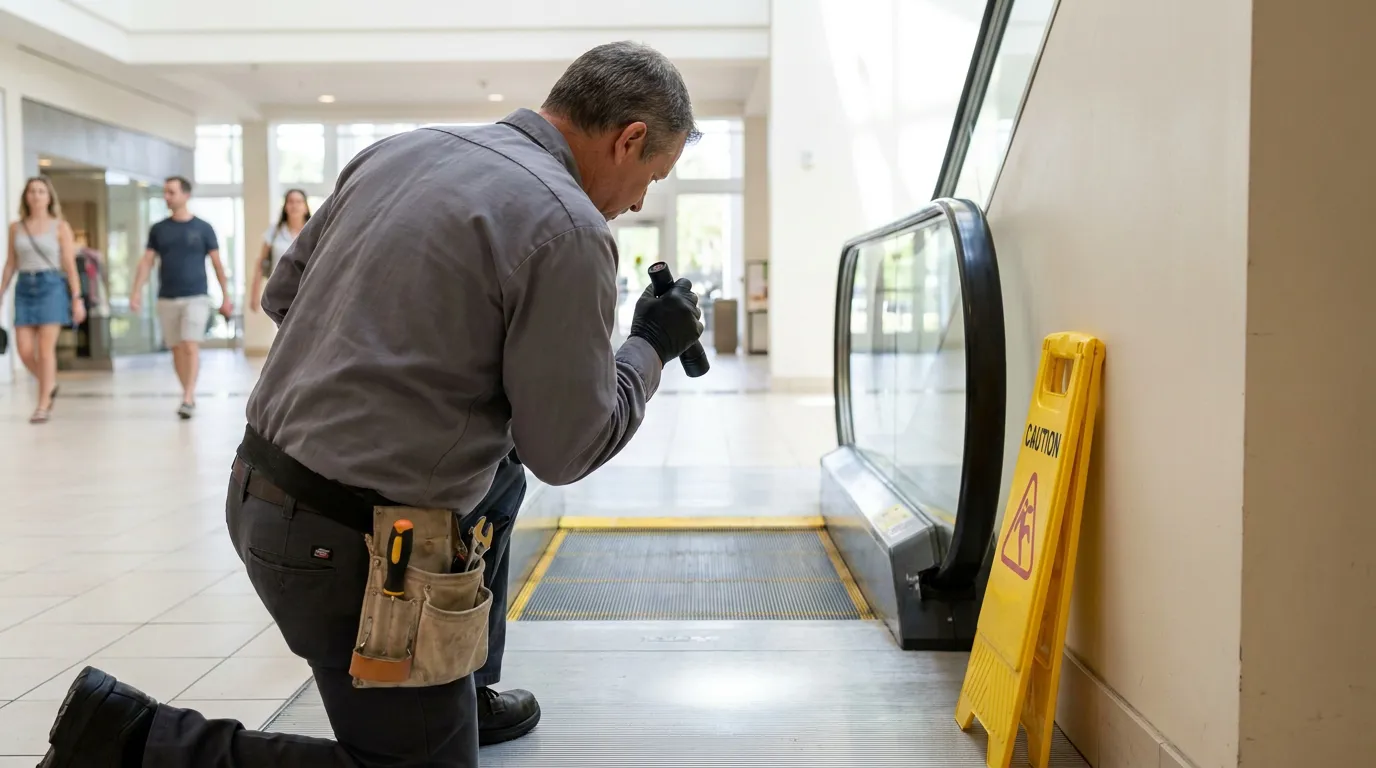
Most escalator injuries trace back to a mechanical problem, a maintenance failure, or an unaddressed hazard. Riders may be hurt when a step collapses or separates, when the unit stops abruptly and throws passengers forward, when a handrail moves at a different speed than the steps, or when the comb plate catches shoes and clothing. Entrapment injuries involving fingers, feet, and loose clothing are common, particularly for children and older adults.
These injuries are often more serious than a typical store fall. A sudden stop on a moving stairway can send someone tumbling down a metal incline, potentially causing fractures, torn ligaments, degloving injuries, dental trauma, spinal damage, and head injuries. Many clients feel "fine" leaving the mall, then wake up barely able to move, one reason prompt medical evaluation matters.
Certain hazards may be foreseeable because they repeat. Worn steps, missing skirt brushes, misaligned comb teeth, broken emergency stop buttons, and deferred service tend to cause the same incidents repeatedly. Evidence of a hazard's history may help establish that the owner should have known about the condition.
The Legal Foundation of a Premises Liability Escalator Case
Escalator claims sit within Florida premises liability law, which generally holds property owners and operators responsible for injuries caused by hazardous conditions on their property. As property owner responsibility background explains, owners must keep property reasonably safe for lawful visitors, and liability typically requires showing the owner had actual or constructive notice of the hazard and failed to remedy it in reasonable time. Business invitees, shoppers, hotel guests, travelers, are owed the most protective duty: maintain reasonably safe premises and warn of concealed dangers.
Proving a claim generally requires four elements: duty, breach, causation, and damages. Duty means the owner owed a legal obligation of care. Breach means they failed to inspect, maintain, repair, or warn as a reasonably careful business would. Causation ties that failure to your injury, and damages are the measurable harm suffered. Outcomes depend heavily on specific facts.
One Florida notice statute applies specifically to slips on transitory substances. Under Fla. Stat. § 768.0755, an injured person must prove the business had actual or constructive knowledge of the dangerous condition and should have remedied it. Some escalator falls, spilled drinks, tracked-in rain, grease on steps, fit this scenario, while falls caused by mechanical failure are instead governed by ordinary negligence principles.
Proving Constructive Knowledge in an Escalator Case
Constructive knowledge means the business should have known about the hazard even if nobody reported it. Section 768.0755 allows this to be proven by circumstantial evidence that the condition existed long enough that ordinary care should have discovered it, or that it occurred with regularity and was foreseeable. Where the statute doesn't apply, courts use common-law negligence principles, a broken step or malfunctioning sensor left unrepaired for weeks may support a finding the owner should have known.
The statute does not eliminate other duties owners owe visitors. Section 768.0755 does not affect common-law duties of care, so an escalator accident lawyer may also pursue negligent maintenance, negligent inspection, and failure-to-warn theories independent of the transitory substance framework. See our discussion of whether businesses must protect customers.
💡 Pro Tip: Photograph the escalator's inspection placard and unit ID number before you leave. That detail often leads directly to the maintenance records that decide the case.
Who May Be Responsible for an Escalator Accident Injury Claim
Escalator cases frequently involve more than one potential defendant, making them more complex than an ordinary floor-level fall. Responsibility may rest with the property owner, management company, a controlling tenant, the escalator service contractor, or the manufacturer of a defective component. Identifying every responsible party early matters, since each may carry separate insurance and point at the others.
| Potentially Responsible Party | Typical Theory of Liability |
|---|---|
| Mall or building owner | Failure to inspect, maintain, or warn of a known hazard |
| Property management company | Negligent oversight of daily operations and safety reporting |
| Escalator maintenance contractor | Negligent service, repair, or inspection of the unit |
| Component manufacturer | Design or manufacturing defect in steps, sensors, or brakes |
| Retail tenant or operator | Failure to remedy hazards within its area of control |
Insurance coverage often funds recovery in these cases. Florida law broadly defines "liability" to include legal responsibility for injuries "arising out of: (a) Any business... premises, or operations" under Fla. Stat. § 627.942(4). Commercial property owners and contractors typically carry general liability coverage for these risks, which is why an adjuster may contact you quickly. Coverage alone doesn't establish liability, and the specific policy terms control.
A narrow statute can potentially change claim value where unlicensed contractor work is involved. Under Fla. Stat. § 768.0425(2), a consumer may be entitled to three times actual compensatory damages plus costs and fees if the contractor is neither state-certified nor locally licensed. This generally applies to residential improvement contexts rather than commercial maintenance, so it will rarely apply in mall or airport escalator cases. Whether it applies at all requires fact-specific investigation.
Florida Deadlines That Can End a Claim Before It Starts
Under current Florida law, negligence actions must generally be commenced within two years. Fla. Stat. § 95.11(5)(a) reflects the 2023 tort reform shortening the prior four-year window for claims accruing after March 24, 2023. Claims accrued on or before that date generally remain subject to the prior four-year period. Because the applicable Chapter 95 limitations period depends on when your claim accrued, confirm the correct deadline with an attorney early.
Fatal escalator accidents generally fall under a two-year window as well, running from the date of death rather than the injury, which matters for families weighing whether to pursue a case after losing a loved one.
Exceptions may exist but are interpreted narrowly. Tolling, delayed discovery, and rules involving minors may apply in limited circumstances and shouldn't be assumed. Claims against a governmental entity involve separate pre-suit notice requirements and damage caps under Fla. Stat. § 768.28. Claims arising on a cruise ship may be governed by federal maritime law with far shorter contractual deadlines. Missing any deadline generally bars recovery entirely.
💡 Pro Tip: Surveillance video from malls, airports, and hotels is often overwritten within days or weeks. A written preservation letter sent early is frequently the difference between having footage and having only a memory.
What to Do After a Shopping Mall Escalator Injury
The steps you take in the first hours often shape the entire case. Evidence is typically controlled by the property owner, not you, and tends to vanish quickly. Practical protective steps generally include:
- Report the incident to management immediately and request a copy of the written incident report
- Photograph the escalator, the specific step or handrail involved, warning signs, and your visible injuries
- Collect names and phone numbers from witnesses, including responding employees
- Seek medical attention the same day and describe exactly how the injury occurred
- Keep the shoes and clothing you were wearing, unwashed, in a bag
- Decline a recorded statement to an insurer until you've spoken with a lawyer
Expect comparative negligence arguments. Under Fla. Stat. § 768.81, Florida's modified comparative negligence framework generally allows recovery even with partial fault, reduced by that percentage, though a claimant found more than fifty percent at fault is generally barred from recovery. Insurers often argue distraction, phone use, improper footwear, or failure to use the handrail. Thorough documentation is an effective response.
Working with an escalator injury attorney in Broward County lets someone else handle the pressure while you recover. A lawyer can send preservation demands, obtain maintenance histories, consult engineers, and handle adjuster communications. An early conversation with a Fort Lauderdale escalator attorney costs nothing and may prevent avoidable mistakes.
Compensation Available in an Escalator Injury Lawsuit
Damages generally fall into economic and non-economic categories. Economic damages may include emergency care, surgery, physical therapy, future treatment, lost wages, and diminished earning capacity. Non-economic damages address pain, suffering, disfigurement, and loss of enjoyment of life, with value depending on injury severity and permanence.
No attorney can promise a particular result. Claim strength generally depends on notice evidence, maintenance records, medical documentation, and how clearly liability traces to a specific party.
Frequently Asked Questions
1. How long do I have to file an escalator accident injury claim in Florida?
Most negligence claims accruing after March 24, 2023 must generally be filed within two years under Fla. Stat. § 95.11(5)(a). Certain circumstances, including claims against government entities or in maritime settings, may alter this timeline, but exceptions are narrowly construed. Confirm your specific deadline with an attorney as soon as possible.
2. What if the escalator was maintained by an outside company?
Maintenance contractors are frequently named alongside property owners. Service agreements, inspection logs, and repair tickets may reveal whether a known defect was documented and ignored. Where uncertified or unlicensed contractor work is involved, Fla. Stat. § 768.0425(2) may allow enhanced damages, though it applies only in limited circumstances.
3. Can I still recover if I was looking at my phone when I fell?
Possibly. Florida's comparative negligence rule generally permits recovery reduced by your share of fault, so long as you're not found more than fifty percent responsible. Fault apportionment is a fact-specific question.
4. What if my child was hurt on an escalator?
Children are frequently involved in escalator entrapment and fall injuries, often involving hands, feet, and footwear. A parent or guardian generally brings the claim on the child's behalf, court approval may be required for certain settlements, and timing rules may differ for minors. These cases may warrant prompt legal review given potential long-term treatment needs.
5. Should I accept the first offer from the property's insurer?
Early offers frequently arrive before the full scope of treatment is known. Once a release is signed, reopening the claim is generally not possible absent limited exceptions. Having the offer reviewed before responding is almost always worthwhile.
Moving Forward After an Escalator Injury
An escalator accident injury claim in Fort Lauderdale generally rests on showing that a property owner, operator, or maintenance company knew or should have known about a dangerous condition and failed to fix it, and that this failure caused real harm. Florida's two-year negligence deadline, its notice and constructive knowledge standards, and its comparative negligence rules all shape what recovery may look like, and each depends on evidence that fades fast. The sooner the investigation begins, the stronger the record tends to be.
You do not have to figure this out alone. Reach out to our Fort Lauderdale personal injury attorneys at Englander Peebles by calling 954-226-9134 or using our free case review form to discuss your situation and get guidance specific to your circumstances.
Disclaimer: This content is for informational purposes only and is not legal advice. Every case is unique, and results may vary. Consult an attorney about your specific circumstances.