Falling on a Broken Broward Sidewalk Is Not Like Falling in a Store
Key Takeaways: Falling on a government-maintained sidewalk in Broward County triggers a different process than a fall on private property because Fla. Stat. § 768.28 waives sovereign immunity only under strict conditions. You must present written notice to the responsible agency and, for non-municipal and non-county claims, to the Florida Department of Financial Services within 3 years of accrual (2 years for wrongful death), then wait for denial or the statutory period to pass before filing suit. Preparing that notice requires identifying the correct entity, City of Fort Lauderdale, Broward County, FDOT, or a private owner, and documenting the hazard with dated photographs, medical records, and witness information. Deadlines run on parallel tracks: a four-year limit under Fla. Stat. § 768.28(14) and a two-year negligence period under Fla. Stat. § 95.11(5)(a) for claims accruing after March 24, 2023. Recovery is capped at $200,000 per person and $300,000 per incident absent a legislative claim bill, and Florida's modified comparative negligence rule can reduce or bar recovery if you are found more than 50 percent at fault. Most notice failures stem from naming the wrong entity, vague location details, or missed service requirements.
When the sidewalk that hurt you belongs to a city, county, or the state, the rules change before your claim reaches a courthouse. Suing a public entity in Florida requires written pre-suit notice of claim delivered to the right offices before a lawsuit can be filed. That extra step catches many injured people by surprise, and missing it can end an otherwise strong case.
Englander Peebles has spent years helping injured people across Broward County navigate claims against public entities. If you are unsure who controls the sidewalk where you fell or how much time you have left, call 954-226-9134, contact us now, or learn more about how Englander Peebles handles South Florida injury claims.
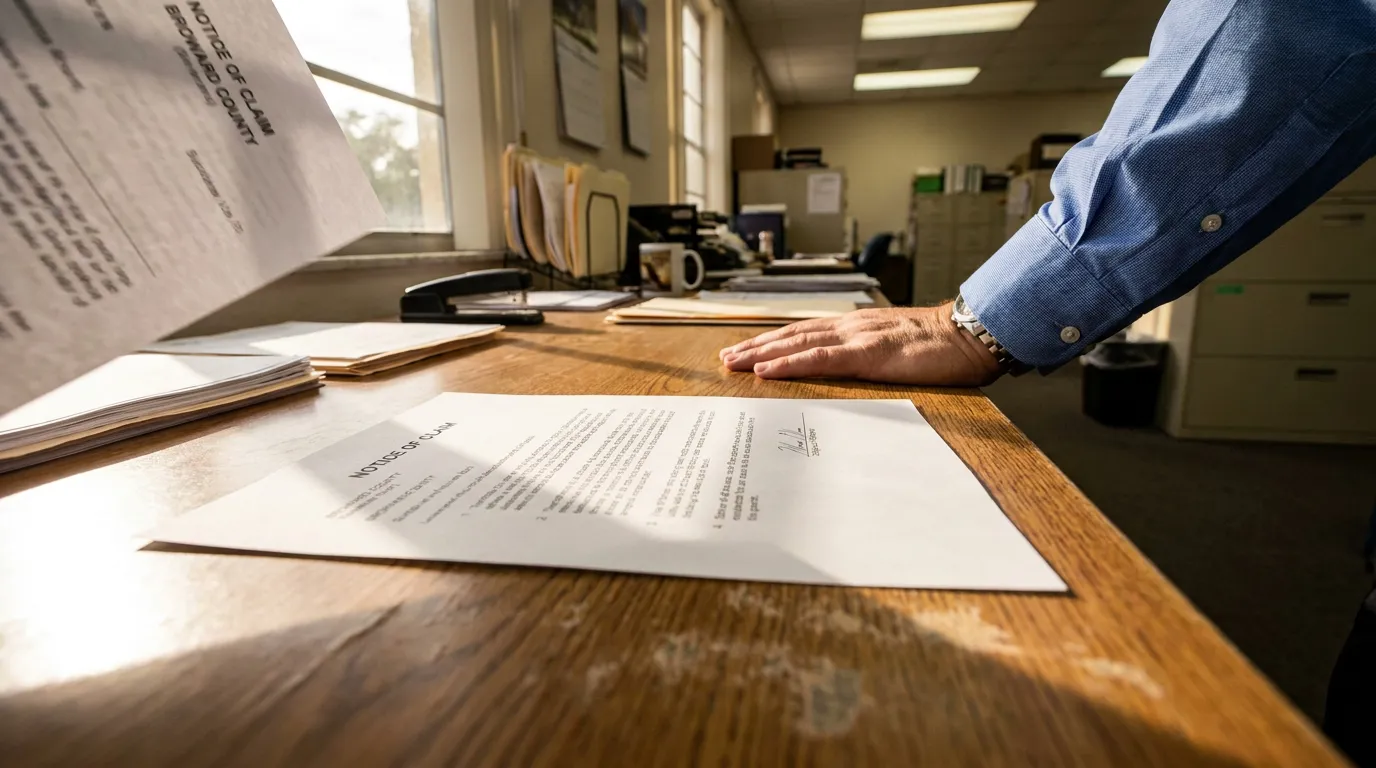
Why Sovereign Immunity Controls a Public Entity Injury Claim
Florida governments are generally immune from lawsuits unless the Legislature has waived that immunity. Under Fla. Stat. § 768.28, "the state, for itself and for its agencies or subdivisions, hereby waives sovereign immunity for liability for torts, but only to the extent specified in this act." That waiver allows a person injured by a poorly maintained public sidewalk to seek compensation and comes with conditions attached. The waiver reaches only operational-level conduct; discretionary planning decisions such as roadway design or maintenance budgets generally remain immune.
Because the waiver is limited, every requirement matters. Courts treat the pre-suit conditions in Fla. Stat. § 768.28(6) as mandatory, and a suit filed without satisfying them is subject to dismissal. The full text of Florida's sovereign immunity waiver statute is published by the Florida Senate.
Fla. Stat. § 768.28 caps what a government entity may pay without legislative action. Judgments "may be settled and paid pursuant to this act up to $200,000 or $300,000, as the case may be," with anything above requiring a claim bill from the Legislature. The $200,000 limit applies per person and the $300,000 limit applies to all claims from the same incident.
The Florida 768.28 Notice of Claim Sidewalk Fall Process, Step by Step
Preparing a notice of claim is a documentation exercise before it is a legal one. Under Fla. Stat. § 768.28(6)(a), "an action may not be instituted on a claim against the state or one of its agencies or subdivisions unless the claimant presents the claim in writing to the appropriate agency." For claims against a state agency or subdivision other than a municipality, a county, or the Florida Space Authority, the claimant must also present the claim to the Florida Department of Financial Services within 3 years after accrual; claims against a municipality or a county are excepted from that second filing. Suit may not begin until the claim is denied in writing or the statutory waiting period passes, generally 6 months (90 days for wrongful death).
Identify the Right Public Entity First
Sidewalk responsibility in Broward County is fragmented. A single stretch of walkway may be maintained by the City of Fort Lauderdale, Broward County, the Florida Department of Transportation, or an adjacent private owner under local ordinance. Determining control often requires plat maps, right-of-way records, and maintenance logs.
Build the Sidewalk Fall Paperwork
A strong written notice describes the incident with enough specificity that the agency can investigate it. Most notices include the claimant's identifying information, the date and precise location of the fall, a factual description of the hazard, injuries claimed, and supporting documentation such as photographs and medical records. Typical documentation includes:
- Dated photographs showing the height differential, crack, or obstruction from multiple angles
- Medical records and bills tied to the fall date
- Names and contact information for witnesses
- Proof of lost wages and out-of-pocket costs
- Any prior complaints or work orders about the same sidewalk section
💡 Pro Tip: Photograph the hazard with a common object such as a coin for scale. Municipal crews sometimes repair defects after a fall, and a repaired sidewalk cannot be measured later.
Serve the Notice the Right Way
A notice of claim is not filed with a court. As consumer legal guidance on injury claims against the state explains, the notice is delivered, often by certified mail, to the responsible agency. Certified mail with return receipt creates proof of delivery.
Deadlines That Can Quietly End a Public Entity Injury Claim
Two different clocks run simultaneously, and they do not measure the same thing. The pre-suit notice deadline is an administrative prerequisite, while the statute of limitations governs when a lawsuit must be filed. Both must be satisfied.
| Requirement | Governing Statute | General Timeframe |
|---|---|---|
| Written notice to agency and Department of Financial Services | Fla. Stat. § 768.28(6)(a) | Within 3 years after accrual (2 years for wrongful death); no DFS notice required for municipalities or counties |
| Filing suit against a state agency or subdivision | Fla. Stat. § 768.28(14) | Within 4 years after accrual |
| General negligence limitations period | Fla. Stat. § 95.11(5)(a) | Within two years for claims accruing after March 24, 2023 |
The interaction between these provisions is where cases get lost. Fla. Stat. § 768.28(14) states that a negligence claim against the state or its agencies "shall be forever barred unless the civil action is commenced... within 4 years after such claim accrues." Meanwhile, 2023 tort reform amended Fla. Stat. § 95.11(5)(a) so that actions "founded on negligence" must generally be brought within two years. How the shortened general negligence period interacts with the four-year provision has not been definitively settled, so the prudent approach is to calendar the earliest applicable deadline.
Accrual itself is defined by statute. Fla. Stat. § 95.031 provides that the limitations clock runs from when the cause of action accrues, meaning when the last element such as the injury occurs.
Tolling and delayed discovery exist, but they are narrow. Statutory tolling grounds are primarily limited to those listed in Fla. Stat. § 95.051, and Florida courts generally may not create new tolling exceptions by judicial fiat; however, Florida courts have recognized at least one judicially created exception, equitable tolling, in limited circumstances such as administrative exhaustion, as established by the Florida Supreme Court in Machules v. Department of Administration (1988). If you are reading this months or years after a fall, speak with a Broward sidewalk injury lawyer promptly.
Common Problems in Preparing a Notice of Claim
Most notice problems trace back to incomplete facts. Naming the wrong entity, describing the location imprecisely, omitting the Department of Financial Services notice where required, or filing suit before the statutory waiting period runs are all recurring issues that can create defenses unrelated to the severity of your injuries.
Comparative Negligence Still Applies
Expect the entity to argue you should have seen the hazard. Under Fla. Stat. § 768.81, as amended in 2023, Florida follows modified comparative negligence: an injured person's recovery is reduced by their percentage of fault, and a person found more than 50 percent at fault recovers nothing. Photographs showing poor lighting, obscuring vegetation, or a defect hidden by shadow can meaningfully affect how that argument plays out, which is why early trip and fall documentation matters.
💡 Pro Tip: Report the fall to the agency's public works department the same week it happens and keep the reference number. An incident record created close in time is harder to dispute later.
Frequently Asked Questions
1. Do I have to send a notice of claim if I fell on a private sidewalk in Fort Lauderdale?
Generally, no. The pre-suit notice requirement in Fla. Stat. § 768.28(6)(a) applies to claims against the state and its agencies or subdivisions. A fall on privately maintained property typically proceeds as an ordinary premises liability claim, though determining ownership and maintenance responsibility can be fact-dependent.
2. What happens after I serve the notice of claim?
The agency reviews and investigates. Under Fla. Stat. § 768.28(6), suit generally cannot begin until the claim is denied in writing or the statutory waiting period expires, 6 months for most claims and 90 days in wrongful death cases.
3. Does the two-year negligence deadline or the four-year government deadline control my case?
It depends on your accrual date. Fla. Stat. § 768.28(14) provides a four-year window for negligence suits against government entities, while Fla. Stat. § 95.11(5)(a) sets a two-year period for negligence actions accruing after March 24, 2023. Because the interaction has not been conclusively resolved, most attorneys calendar the earliest applicable date.
4. Can I recover more than the statutory cap?
Not without legislative action. Fla. Stat. § 768.28 limits payment to $200,000 per person and $300,000 per incident absent a claim bill passed by the Florida Legislature. A court may enter a judgment above the caps, but the excess is payable only through a claim bill.
5. What if the city repaired the sidewalk before I took photos?
Your claim is not automatically lost. Maintenance records, prior complaints, permit histories, and witness testimony may still establish the condition that existed. These records often require formal public records requests, which is another reason to involve counsel early.
Protecting a Sidewalk Injury Claim Starts With the Paperwork
A Broward trip and fall against a public entity succeeds or fails on procedure as much as proof. Identifying the correct agency, preparing a thorough written notice, serving both the agency and the Department of Financial Services where required, and tracking every applicable deadline are the foundation of a viable claim. You can find more guidance on Broward injury claims in our other articles.
If you were hurt on a public sidewalk anywhere in Broward, Miami-Dade, or Palm Beach County, do not wait to get answers. Call 954-226-9134, reach out to our Fort Lauderdale personal injury attorneys, or visit Englander Peebles online to get started. Call us today for a free consultation.