Winning a Left-Turn Collision Claim in Broward County
Key Takeaways: Proving fault in a Fort Lauderdale left-turn crash requires showing the turning driver violated Florida Statute 316.122 by failing to yield to oncoming traffic. Success depends on early evidence: photographs, witness statements, the Florida Traffic Crash Report, and prompt medical records. You must establish duty, breach, causation, and damages. A circular green light never excuses a turning driver's duty to yield. Florida's no-fault system means PIP applies first, and serious injuries are needed to pursue claims beyond those limits. Under modified comparative fault rules, anyone found more than 50 percent at fault recovers nothing. Act quickly because evidence disappears and a two-year statute of limitations generally applies.
Proving fault in a left-turn crash in Fort Lauderdale starts with showing the turning driver failed to yield to oncoming traffic. Under Florida law, a driver turning left must yield to vehicles approaching from the opposite direction that are within the intersection or close enough to be an immediate hazard. When that duty is breached, the left-turning driver is usually presumed at fault, though that presumption can be rebutted. Building a strong claim requires evidence, understanding of statutes, and prompt action.
If you were hurt in a turning collision and want guidance specific to your situation, the team at Englander Peebles is ready to help. Call us today for a free consultation at 954-226-9134 or reach out through our online contact page to discuss your options.
Why Left-Turn Drivers Usually Carry the Blame
Florida places a clear legal duty on the driver who chooses to turn across oncoming traffic. The driver of a vehicle intending to turn to the left within an intersection or into an alley, private road, or driveway shall yield the right-of-way to any vehicle approaching from the opposite direction, or vehicles lawfully passing on the left of the turning vehicle, which is within the intersection or so close thereto as to constitute an immediate hazard. This rule comes from Florida Statute 316.122, part of the state's broader Florida uniform traffic control statutes.
This duty to yield is the legal foundation for proving the turning driver was negligent. A violation of this section is a noncriminal traffic infraction, punishable as a moving violation. A citation issued under this section serves as meaningful evidence of negligence in a civil claim, though it is not conclusive on liability. The duty applies to turns into alleys, private roads, and driveways.
💡 Pro Tip: A traffic ticket issued to the other driver does not automatically win your case, but it is strong supporting evidence. Share it with your attorney.
How to Win a Left-Turn Accident Case With the Right Evidence
Knowing how to win a left turn accident claim comes down to documentation gathered early and preserved carefully. Memories fade, vehicles get repaired, and surveillance footage is often overwritten within days. The sooner you collect proof, the stronger your position when an insurer disputes fault.
Strong left turn collision evidence generally falls into a handful of categories:
- Photographs and videos of the scene, vehicle positions, and traffic signals
- Witness names and contact information
- Your written account of what happened while it is fresh
- The official police report and any traffic camera or surveillance footage
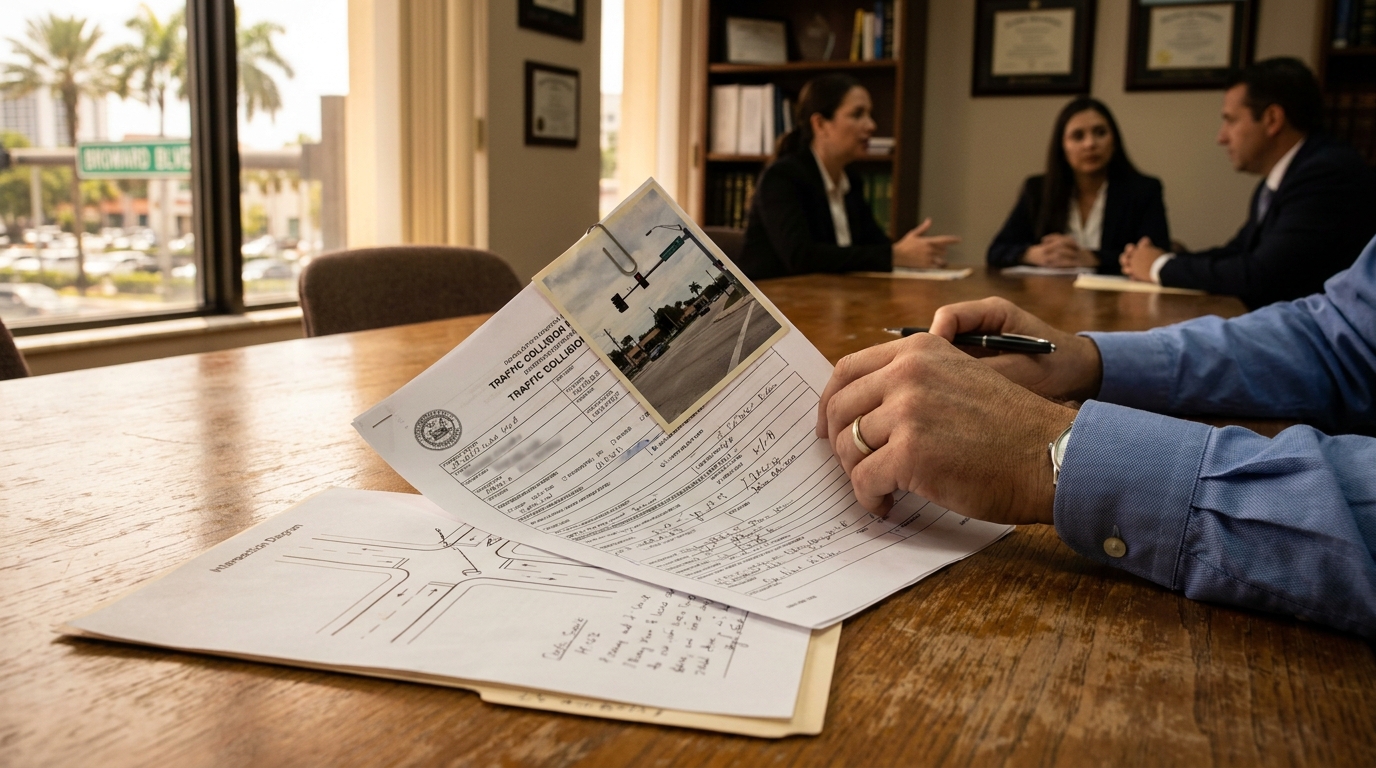
The police report carries particular weight in Broward County car accident claims. Florida law requires any driver involved in a crash resulting in injury, death, or property damage of at least $500 to immediately give notice to the local police department, the county sheriff, or the Florida Highway Patrol. In Fort Lauderdale, that means contacting Fort Lauderdale PD, the Broward County Sheriff's Office, or the Florida Highway Patrol. This mandatory report triggers an official Florida Traffic Crash Report that captures the responding officer's observations, witness names, vehicle descriptions, insurance information, and the officer's determination of which driver committed a traffic violation.
💡 Pro Tip: Ask the responding officer how to obtain a crash report copy and write down the report number before leaving the scene.
The Four Elements You Must Prove
Proving fault in any failure-to-yield accident means establishing the four elements of negligence: duty of care, breach of duty, causation, and damages. Each must connect logically to the next for a claim to succeed.
Duty and Breach in a Turning Crash
Every driver owes a duty to operate their vehicle with reasonable care. For a left-turning driver, that duty includes the statutory obligation to yield. When the driver turns in front of oncoming traffic that is close enough to be a hazard, the breach is demonstrated through failure to follow Florida Statute 316.122.
Lane Position and Turning Method
Florida law also dictates exactly how and where a left turn must be made. Under Florida Statute 316.151(1)(b)1, a driver must approach the intersection in the extreme left-hand lane lawfully available and complete the turn into a lane lawfully available on the road being entered. Violations of proper lane position may be admissible as evidence of negligence.
Causation and Documented Damages
Causation links the breach directly to your injuries, and damages reflect your actual losses. Medical records become essential here. Because Florida operates under a no-fault auto insurance system, your Personal Injury Protection (PIP) coverage generally applies first, regardless of who caused the crash. To pursue a claim against the at-fault driver for noneconomic damages such as pain and suffering, your injuries generally must meet the serious-injury threshold described in Florida Statute 627.737.
💡 Pro Tip: Seek medical care the same day if possible. Gaps in treatment give insurers an opening to argue your injuries were minor. PIP benefits generally require initial treatment within 14 days of the crash.
The Green Light Myth and Common Defenses
A circular green light does not give a turning driver an absolute right to go. Vehicular traffic facing a circular green signal may proceed or turn left, but vehicles turning left shall yield the right-of-way to other vehicles and to pedestrians lawfully within the intersection or an adjacent crosswalk. A circular green light grants permission to proceed, not priority over traffic already in the intersection. A steady green arrow generally provides a protected left turn, but the turning driver must still yield to traffic and pedestrians already lawfully using the intersection.
At-fault drivers and their insurers rarely accept blame quietly. Common defenses include claiming you were speeding, that their vehicle was not visible, that you took a sudden action, or that traffic signals were malfunctioning. Anticipating these arguments is part of building a persuasive claim, which is why early evidence preservation is so valuable. Similar dynamics often appear when a turning driver strikes a two-wheeled rider, explained in our discussion of what happens when a driver turns left into a motorcycle in Ft Lauderdale.
How Comparative Fault Affects Your Recovery
Florida's modified comparative fault system can reduce or eliminate your recovery. In 2023, the state adopted a rule under Florida Statute 768.81(6) that bars any party found more than 50 percent at fault from recovering damages, a change that generally applies to negligence claims filed after March 24, 2023. Insurers in left-turn cases work hard to shift blame onto the oncoming driver by arguing speeding or failure to avoid the collision.
Even when both drivers share some blame, the math matters. Under Florida's comparative fault law, the court enters judgment against each liable party based on that party's percentage of fault rather than joint and several liability. If the turning driver is found 80 percent at fault and you are 20 percent at fault, your damages are reduced proportionally. You can review the full framework in the Florida comparative negligence statute. The chart below shows how a hypothetical award might be reduced.
| Your Assigned Fault | Total Damages | Amount Recoverable |
|---|---|---|
| 0% | $100,000 | $100,000 |
| 20% | $100,000 | $80,000 |
| 50% | $100,000 | $50,000 |
| 51% or more | $100,000 | $0 |
These figures are illustrative only, and every case turns on its own facts. A knowledgeable advocate can help present evidence that keeps your share of fault low. Strong proof, including reconstruction and witness testimony, often makes the difference in proving negligence in a left turn crash.
💡 Pro Tip: Avoid apologizing or speculating about fault at the scene. Even an offhand "I didn't see them" can be twisted into an admission.
Why Acting Quickly Protects Your Claim
Time limits and disappearing evidence both work against accident victims who wait. In Florida, the statute of limitations for a negligence-based personal injury claim accruing on or after March 24, 2023 is generally two years from the date of the incident. This civil deadline is separate from the mandatory crash-reporting obligation.
Prompt legal help means evidence is preserved before it vanishes. Surveillance footage gets erased, skid marks fade, and witnesses become harder to locate. Our Fort Lauderdale car crash attorneys can move quickly to secure records and, when appropriate, retain reconstruction professionals. To learn how our team approaches these claims, visit our Fort Lauderdale accident lawyer page.
Frequently Asked Questions
1. Is the left-turning driver always at fault in a Florida crash?
Usually, but not automatically. The turning driver carries a strong presumption of fault under Florida Statute 316.122, yet the oncoming driver's speeding or other conduct can shift blame under comparative fault principles.
2. What evidence best proves a left turn collision claim?
A combination of sources is most persuasive. Photographs, video, witness statements, the Florida Traffic Crash Report, and your written account together establish how the crash occurred and who failed to yield.
3. Does PIP cover my injuries in a left-turn crash?
Your PIP coverage generally applies first, regardless of fault. To pursue compensation beyond those limits, your injuries must meet Florida's serious-injury threshold, and you must seek initial treatment within 14 days.
4. How long do I have to file a claim in Fort Lauderdale?
Florida generally allows two years from the date of the crash for negligence claims arising after the March 2023 reform. Confirm your timeline with counsel promptly.
5. What if the other driver had a green light?
A green light does not excuse a failure to yield. Florida law still requires turning drivers to yield to traffic and pedestrians already lawfully in the intersection or adjacent crosswalk.
Putting Your Left-Turn Case on Solid Ground
Winning a left-turn crash claim in Fort Lauderdale comes down to proving the turning driver breached the duty to yield and caused your harm. That means preserving photographs, witness details, and the police report, understanding how the green-light rule and comparative fault apply, and acting before evidence disappears or deadlines pass.
You do not have to sort through these statutes and insurance tactics alone. Reach out to our Fort Lauderdale personal injury attorneys at Englander Peebles by calling 954-226-9134 or using our secure contact form. Contact Englander Peebles today for a free consultation and let us help you protect your right to fair compensation.