Understanding Shared Fault After a Broward County Truck Wreck
Key Takeaways: Comparative negligence in a Ft Lauderdale truck crash allows you to recover compensation even when partly to blame, with your award reduced by your fault percentage. Since 2023, Florida follows modified comparative negligence under FL § 768.81(6), meaning anyone over 50% at fault recovers nothing, while those 50% or less at fault receive reduced damages. Florida no longer uses joint and several liability, so each at-fault party pays only its proportionate share, and defendants may shift blame to non-parties under strict requirements. Violations of federal trucking regulations (49 C.F.R. parts 382, 397) can strengthen your claim by shifting fault percentages. Because crossing the 50% threshold eliminates recovery entirely, preserving evidence early and securing skilled representation are critical.
Comparative negligence in a Ft Lauderdale truck crash is the legal rule that lets you recover money even if you were partly to blame, while reducing your award by your share of the fault. When a loaded semi collides with a passenger vehicle on I-95 or I-595, insurers will almost always argue you share responsibility. Understanding how this works is essential to protecting what you are owed.
If you were hurt in a commercial truck collision in Broward County, you should not face the carrier and its insurer alone. Call Englander Peebles at 954-226-9134, reach out through our Fort Lauderdale contact page, or learn more about how our South Florida injury team helps truck crash victims. The sooner you act, the easier it is to preserve critical evidence.
What Comparative Negligence Means Under Florida Law
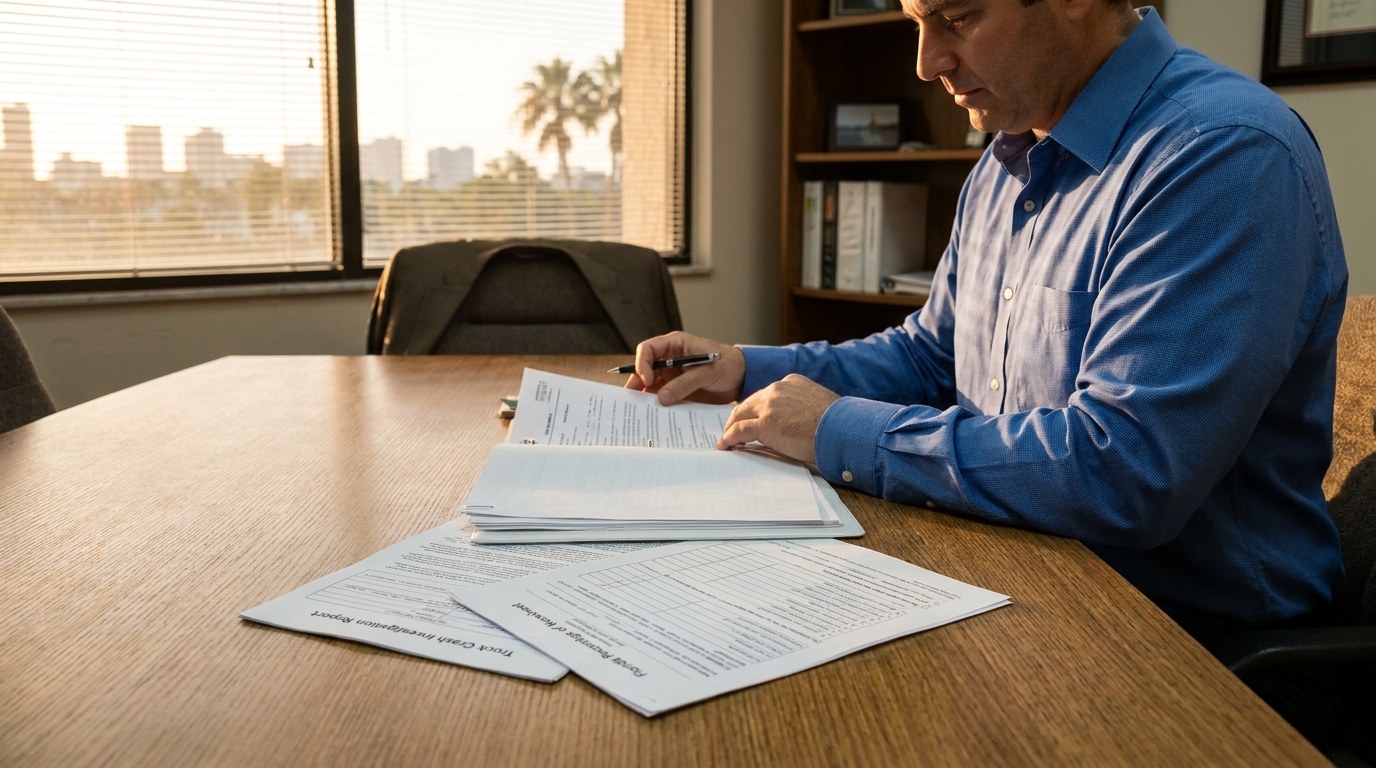
Florida applies comparative negligence to spread responsibility among everyone whose conduct contributed to a crash. Instead of an all-or-nothing approach, a jury assigns each party a percentage of fault, and damages are adjusted accordingly. The Cornell Law School definition of comparative negligence explains how courts divide blame among parties.
Several states take different approaches to this problem. Understanding the alternatives helps Broward County victims recognize why Florida's framework matters.
| System | How Fault Affects Recovery |
|---|---|
| Pure comparative negligence | Damages are reduced in proportion to the victim's fault |
| Modified comparative negligence | Recovery barred at the 50% or 51% threshold |
| Contributory negligence | Any fault by the victim bars recovery |
Historically, Florida followed the pure comparative model. Under that rule, plaintiffs could recover even when 99% at fault. That changed significantly in 2023, which is why the current statute matters for any Ft Lauderdale truck crash claim.
💡 Pro Tip: Do not assume the insurer's fault estimate is accurate. Adjusters often inflate a victim's percentage to shrink the payout, so document the scene, vehicle positions, and road conditions immediately.
How Florida's 2023 Modified Comparative Negligence Reform Works
Florida now operates under modified comparative negligence with a hard cutoff. Under the 2023 amendment, FL § 768.81(6) provides that any party over 50% at fault for their own harm may not recover damages. If you are 50% or less at fault, you can still recover, but your award is reduced by your percentage. This applies to most negligence actions, though medical negligence claims remain governed by pure comparative negligence. Review the controlling rules in Chapter 768 of the Florida Statutes.
The 50% Threshold in Practice
This threshold can make or break a Ft Lauderdale truck crash claim. Suppose a jury awards $400,000 but finds you 30% responsible. You would recover $280,000. Cross the 50% line, however, and recovery disappears entirely. Because the difference between 49% and 51% is so consequential, fault allocation is often the central battleground.
How Damages Are Categorized
Florida law recognizes two broad categories of compensable harm:
- Economic damages such as medical bills, lost income, and property damage
- Non-economic damages that account for pain, suffering, and emotional distress
In severe truck collisions, both categories can be substantial. Catastrophic injuries often bring long-term care costs, lost earning capacity, and lasting loss of enjoyment of life. For a deeper explanation of how comparative fault interacts with these awards, our overview of modified comparative negligence in Florida walks through the doctrine in plain language.
When Multiple Parties Share Blame in a Truck Crash
Truck cases frequently involve more than one responsible party. A single semi-truck crash in Broward County might involve the driver, motor carrier, cargo loader, maintenance contractor, and parts manufacturer. Florida no longer uses joint and several liability.
Each Defendant Pays Only Its Share
Under Florida's proportional fault framework, judgment is entered against each defendant based on that party's own percentage. FL § 768.81(3) requires the court to enter judgment against each party based on their percentage of fault, not on joint and several liability. This means recovering full compensation often requires identifying and pursuing every at-fault party.
Watch for Fault Shifted to Non-Parties
Defendants commonly try to point the finger at someone not in the lawsuit. The law allows this, but only under strict conditions. Under FL § 768.81(3)(a), to allocate fault to a nonparty, a defendant must affirmatively plead that fault and prove it at trial by a preponderance of evidence. Recognizing and rebutting these tactics is critical.
💡 Pro Tip: If an insurer suddenly blames a "phantom" loader or manufacturer, preserve maintenance logs, loading records, and inspection reports before they disappear.
Employer and employee fault can also overlap. Florida provides that if both an injured employee and the employer (in specific hazardous occupations such as railroading, operating street railways, generating electricity, telegraph and telephone business, express business, blasting, operating automobiles for public use, and boating with motorized propulsion) are at fault, recovery is proportional to the employer-defendant's share of the combined negligence under FL § 769.03.
How Federal Trucking Rules Affect Fault
Commercial trucks operating through Fort Lauderdale must follow state and federal safety rules. Under FL § 316.302(1)(a)-(b), all owners and drivers of commercial motor vehicles on Florida highways engaged in interstate commerce are subject to 49 C.F.R. parts 382-386 and 390-397, covering hours of service, maintenance, drug testing, and cargo securement.
A violation of these federal rules can directly strengthen your claim. When a trucking company breaks a safety regulation in 49 C.F.R. parts 382 through 397, that conduct may support negligence findings and shift comparative fault percentages in your favor. Because carriers know this, they often resist producing logbooks, electronic data, and maintenance records.
💡 Pro Tip: Federal records like driver hours-of-service logs may be overwritten within months. A preservation letter sent early can stop routine deletion.
Why a Fort Lauderdale Truck Accident Lawyer Makes a Difference
A knowledgeable fort lauderdale truck accident lawyer focuses on keeping your share of fault as low as the evidence allows. Because crossing the 50% line eliminates recovery, every percentage point matters. A skilled fort lauderdale truck accident lawyer investigates the crash, secures federal compliance records, and counters improper blame attempts.
Florida law requires immediate reporting of serious crashes. Section 316.065, Florida Statutes, requires drivers involved in crashes with injury, death, or $500+ in damage to immediately contact law enforcement. That police report often becomes foundational evidence. Our Fort Lauderdale truck accident attorneys handle these complex commercial cases throughout South Florida.
Deadlines deserve careful attention. Florida's standard personal injury limitations period generally applies to truck accident claims. In limited circumstances, the clock may be paused. Under FL § 95.051(1), the running of time may be tolled by absence from the state, use of a false name preventing service, concealment, or adjudicated incapacity. Courts interpret these exceptions narrowly, and the default deadline controls most cases.
💡 Pro Tip: Civil lawsuit deadlines are separate from crash-reporting requirements. Do not assume one extends the other.
Frequently Asked Questions
1. Can I still recover if the crash was partly my fault?
Yes, in many cases. As long as you are 50% or less at fault, you may recover, though damages are reduced by your percentage of responsibility under Florida's modified comparative negligence rule.
2. What happens if I am found more than half at fault?
Recovery is generally barred. If a jury assigns you over 50% blame, the statute bars recovery, which is why fighting inflated fault claims is critical.
3. Are punitive damages available in a truck accident case?
Sometimes, in cases involving egregious conduct. Punitive damages may apply where there is gross negligence, recklessness, or intent. Florida caps punitive damages at three times compensatory damages or $500,000, whichever is greater, subject to exceptions. The US Supreme Court requires punitive damages generally be less than 10 times compensatory damages under the Due Process Clause.
4. Who can be held responsible in a commercial truck crash?
Often more than one party. Depending on the facts, the driver, motor carrier, cargo loader, maintenance provider, or parts manufacturer may share fault, each paying only its proportionate share.
5. How soon should I contact an attorney after a truck crash?
As soon as possible. Critical evidence like electronic logs and maintenance records can be lost quickly, and early legal action preserves proof and protects your rights.
Protecting Your Right to Recover After a Truck Crash
Comparative negligence will shape nearly every commercial truck accident claim in Fort Lauderdale. Florida's modified system means your recovery depends heavily on how fault is divided, and insurers work hard to push more blame onto you. By understanding the statutes, federal safety rules, and the strict 50% threshold, you can approach your claim from a position of knowledge. Personalized guidance is essential.
You do not have to navigate this alone. Call Englander Peebles today at 954-226-9134 for a free consultation, contact our Fort Lauderdale personal injury team online, or visit Englander Peebles to learn how we fight for injured people across South Florida. Reach out to our Fort Lauderdale personal injury attorneys now and let us help protect your right to recover.