Types of Evidence That Matter in a Broward County Truck Collision
Key Takeaways: Proving a truck crash claim in Fort Lauderdale requires physical evidence from the scene, trucking company records, and documentation of damages. Black box data, hours-of-service logs, driver qualification files, and witness statements establish fault. A spoliation letter from your attorney prevents trucking companies from destroying key records. Florida's modified comparative fault rule means you must show the other party bears more than 50 percent of blame to recover damages. Liability may extend beyond the truck driver to the trucking company, vehicle owner, maintenance provider, or cargo loader. With a two-year statute of limitations, acting quickly is essential.
A truck accident on a Fort Lauderdale highway can leave you facing serious injuries, overwhelming medical bills, and uncertainty about what comes next. If you or a loved one was hurt in a collision involving a commercial truck in Broward County, your claim's strength depends on the evidence you collect and preserve. Proving negligence requires documentation that ties the truck driver or trucking company to fault and captures the full scope of your losses.
If you need guidance right now, Englander Peebles is here to help. Call 954-226-9134 or reach out to our team to discuss your situation during a free consultation.
Types of Evidence That Matter in a Broward County Truck Collision
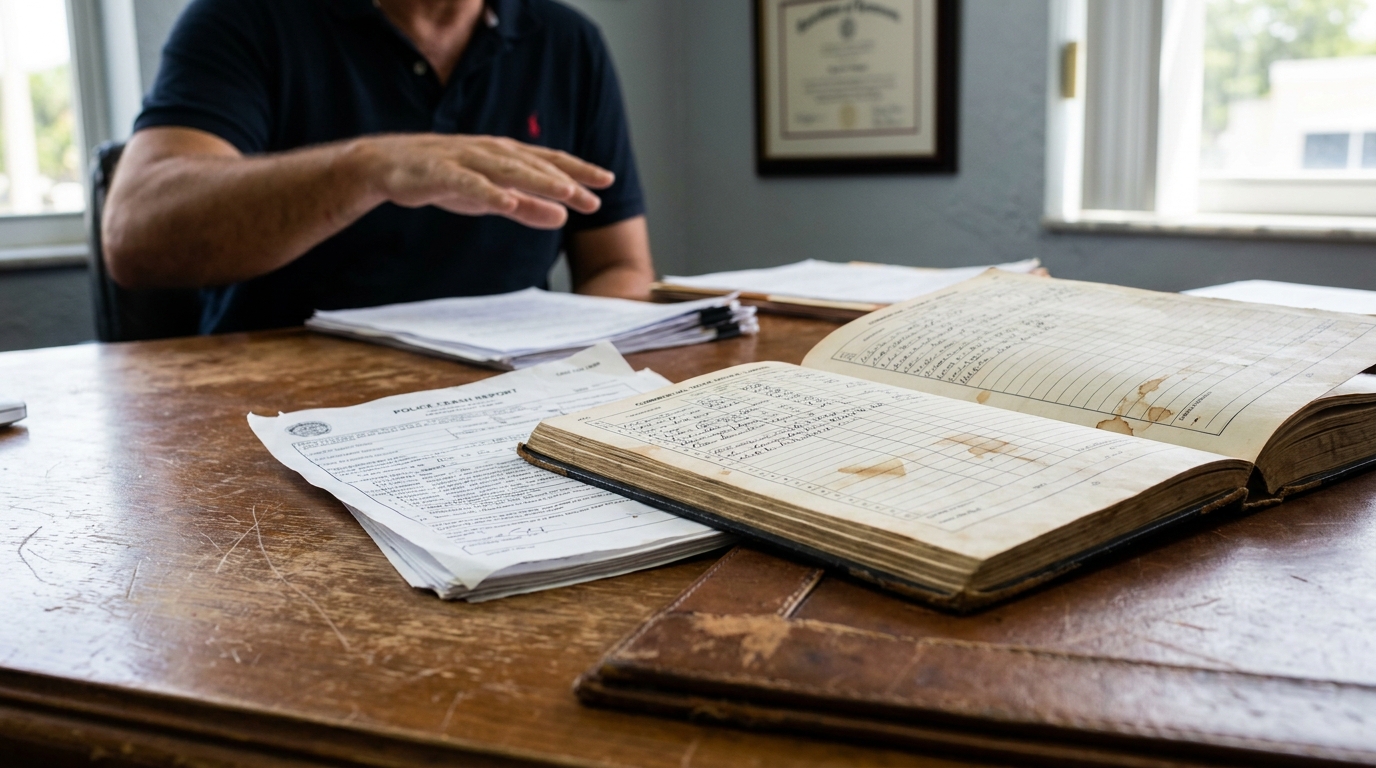
Not all evidence carries the same weight, and knowing what to look for early can make a real difference. Truck crash documentation in Florida typically falls into three categories: physical evidence from the scene, trucking company records, and proof of damages.
Physical evidence from the crash scene is often the most immediate and persuasive. Police reports may identify problems that caused the collision. Photos of vehicles, injuries, skid marks, and road debris help prove liability. Event data recorder information, or "black box" data, can reveal the truck's speed, braking patterns, and mechanical details before impact. This data can disappear quickly if not preserved, which is why contacting an attorney immediately matters.
Eyewitness Statements and Their Role
Witnesses who saw the crash can provide critical support for your version of events. Their statements may be useful in settlement negotiations and at trial. Obtaining contact information from bystanders at the scene should be a priority.
💡 Pro Tip: Write down witnesses' names and phone numbers before leaving the scene. Memories fade fast, and tracking someone down weeks later is much harder.
Trucking Company Records and Federal Regulations
Commercial trucks operating in Florida must comply with state and federal safety rules, and violations can be powerful evidence of negligence. Under Florida Statute § 316.302(1)(a)-(b), all commercial motor vehicle owners and drivers on Florida's public highways are subject to FMCSA regulations in 49 C.F.R. parts 382-386 and 390-397. Hours-of-service logs, vehicle inspection records, maintenance reports, and driver qualification files all fall under this umbrella.
An attorney may send a spoliation letter to the trucking company, demanding preservation of black box data and other critical records. This letter requests the company hold onto drug and alcohol testing results, driver safety records, driver qualifications, truck inspection reports, dispatch instructions, and weigh station records. Without this step, crucial evidence can be overwritten or discarded.
💡 Pro Tip: Trucking companies are not required to keep certain electronic data indefinitely. Acting quickly to send a preservation letter through your attorney can prevent loss of records that may prove negligence.
How Florida's Comparative Fault Rule Affects Your Truck Accident Claim Ft Lauderdale
Florida follows a modified comparative fault system that directly impacts recovery after a truck crash. Under FL § 768.81(6), any party found to be greater than 50 percent at fault for their own harm cannot recover any damages. This means the defense will try to shift blame onto you. This rule does not apply to medical negligence actions under Chapter 766.
Thorough evidence collection is your best defense. Dashcam footage, witness statements, accident reconstruction reports, and truck driver logs establish that the truck driver or trucking company bears the greater share of fault. The more documentation showing the other party's negligence, the harder it becomes for the defense to pin responsibility on you. Knowing what to do after a truck crash in Ft. Lauderdale puts you in the strongest position from day one.
Who Can Be Held Liable Beyond the Truck Driver?
In many truck crash cases, liability extends beyond the person behind the wheel. Under Florida's dangerous instrumentality doctrine, the owner of a motor vehicle may be held vicariously liable for injuries caused by the negligent operation of their vehicle by an authorized driver. This principle, established in Southern Cotton Oil Co. v. Anderson, 86 So. 629 (Fla. 1920), means the trucking company that owns the rig could be liable even if the driver made the mistake.
Negligent hiring is another avenue for holding a carrier accountable. If a trucking company failed to properly vet a driver's qualifications, ignored a poor safety record, or did not enforce federal motor carrier safety requirements, the company itself may bear direct liability. Identifying every potentially responsible party is key to a truck accident investigation in Florida.
| Potentially Liable Party | Basis for Liability | Key Evidence |
|---|---|---|
| Truck Driver | Direct negligence (speeding, fatigue, impairment) | Black box data, hours-of-service logs, drug test results |
| Trucking Company | Vicarious liability, negligent hiring | Driver qualification files, safety records, dispatch logs |
| Vehicle Owner | Dangerous instrumentality doctrine | Ownership records, lease agreements |
| Maintenance Provider | Negligent repair or inspection | Maintenance logs, inspection reports |
| Cargo Loader/Shipper | Improper loading or overweight cargo | Weigh station records, loading manifests |
💡 Pro Tip: Florida law authorizes enforcement of axle and gross weight limits under FL § 316.545(2)(c). If a semi truck involved in your crash was carrying an unlawful load, that violation could serve as evidence of negligence per se, meaning the breach of duty is established by the legal violation itself.
Proving Your Damages After a Semi Truck Crash in Ft Lauderdale
Establishing fault is only half the equation. You also need solid proof of every dollar in losses you have suffered. Pay stubs prove lost wages. Medical records and bills document economic harm. Photos of damaged property round out tangible losses.
Documenting Non-Economic Damages
Pain and suffering, emotional distress, and loss of enjoyment of life are real losses, even without a receipt. A counselor or therapist can provide a professional opinion regarding emotional impact. Photos and videos of daily activities before and after the accident may illustrate changes in quality of life. Testimony from family members and friends who observed these changes can further support a non-economic damages claim.
Social Media: Handle With Care
Social media posts can help prove non-economic damages, but they are a double-edged sword. Defendants or insurers may comb through your accounts looking for posts that contradict your injury claims. A photo from a family gathering, taken out of context, could be used to argue you are not as hurt as you say. The safest approach is to avoid posting about your accident, injuries, or daily activities while your claim is pending.
💡 Pro Tip: Adjust your privacy settings and avoid accepting new friend requests from people you do not know while your case is open. Insurance adjusters have been known to monitor claimants' social media activity.
Critical Deadlines: Why a Fort Lauderdale Truck Accident Lawyer Should Review Your Case Early
Florida imposes strict time limits on filing a truck accident lawsuit, and missing them can end your case. Under FL § 95.11(5)(a), an action founded on negligence must be filed within two years of the accident date. This deadline was reduced from four years by HB 837, effective March 24, 2023.
Certain circumstances may pause or "toll" the statute of limitations, but courts interpret these exceptions narrowly. Under FL § 95.051(1)(a)-(c), the limitations period may be tolled if the defendant is absent from the state, uses a false name unknown to the plaintiff, or conceals themselves to prevent service of process. For Broward County truck accident claimants, this could be relevant when an out-of-state trucking company attempts to evade service.
If your crash involved a government-owned truck, a different deadline may apply. Under FL § 768.28(14), claims against the state or a subdivision must generally be commenced within four years, but additional procedural requirements, including prior written notice to the appropriate agency and Department of Financial Services, must be met before filing suit.
Overweight and Unpermitted Trucks
The Florida Department of Transportation may issue special overweight permits for commercial vehicles under FL § 316.550(4)(a)-(c). If a truck involved in your collision was operating without a required permit, or traveling a route not authorized by its permit, that fact constitutes evidence of a statutory violation relevant to proving negligence. DOT permit records, weigh station data, and post-accident weight measurements can all help establish this.
💡 Pro Tip: An experienced fort lauderdale truck injury attorney can subpoena trucking company records, obtain DOT permit files, and work with accident reconstruction professionals to build the strongest possible case.
Frequently Asked Questions
1. What is the most important piece of evidence in a truck accident claim?
There is no single piece of evidence that wins a case. Black box data, police reports, driver logs, and medical records each serve a different purpose. Together, they create a comprehensive picture of fault and damages.
2. How long do I have to file a truck accident lawsuit in Fort Lauderdale?
Under FL § 95.11(5)(a), the statute of limitations for a negligence-based personal injury lawsuit in Florida is generally two years from the accident date. Missing this deadline typically bars recovery.
3. Can I still recover damages if I was partially at fault for the truck crash?
Under Florida's modified comparative fault rule in FL § 768.81(6), you may recover damages as long as you are not more than 50 percent at fault. Your recovery would be reduced by your percentage of responsibility. Strong evidence of the truck driver's or trucking company's negligence is essential.
4. What records should be preserved from the trucking company?
Key records include black box data, hours-of-service logs, drug and alcohol testing results, driver qualification files, vehicle inspection reports, dispatch instructions, and weigh station records. A spoliation letter sent by your attorney ensures these documents are not destroyed.
Protect Your Claim by Acting Quickly
Evidence in a Broward County truck collision case can disappear faster than you expect. Black box data gets overwritten, witnesses become harder to locate, and trucking companies have no obligation to hold records unless properly notified. The sooner you begin preserving evidence, the stronger your claim will be.
Englander Peebles is ready to help you take the next step. Call 954-226-9134 or contact us today for a free consultation.